
You have an LNB, and it has a small antenna inside. So why do you still need that big satellite dish? The two must work together to capture a usable signal.
An LNB cannot function effectively for satellite reception without a dish. The dish's large surface area is essential for capturing the extremely weak satellite signal and concentrating its power onto the LNB's feedhorn. Without the dish, the LNB's tiny internal antenna would not gather enough signal to work.

I asked my mentor this exact question years ago. He explained that the dish and the LNB are a team, and you can't have one without the other. Understanding their distinct roles is key to appreciating satellite system design. To really get it, we need to look at why satellite signals are so faint in the first place. This journey from space is what makes the whole system necessary.
Why are satellite signals so incredibly weak?
You know signals from space are weak. But they are so faint that they are almost lost in the background noise of the universe. We need to understand their long journey.
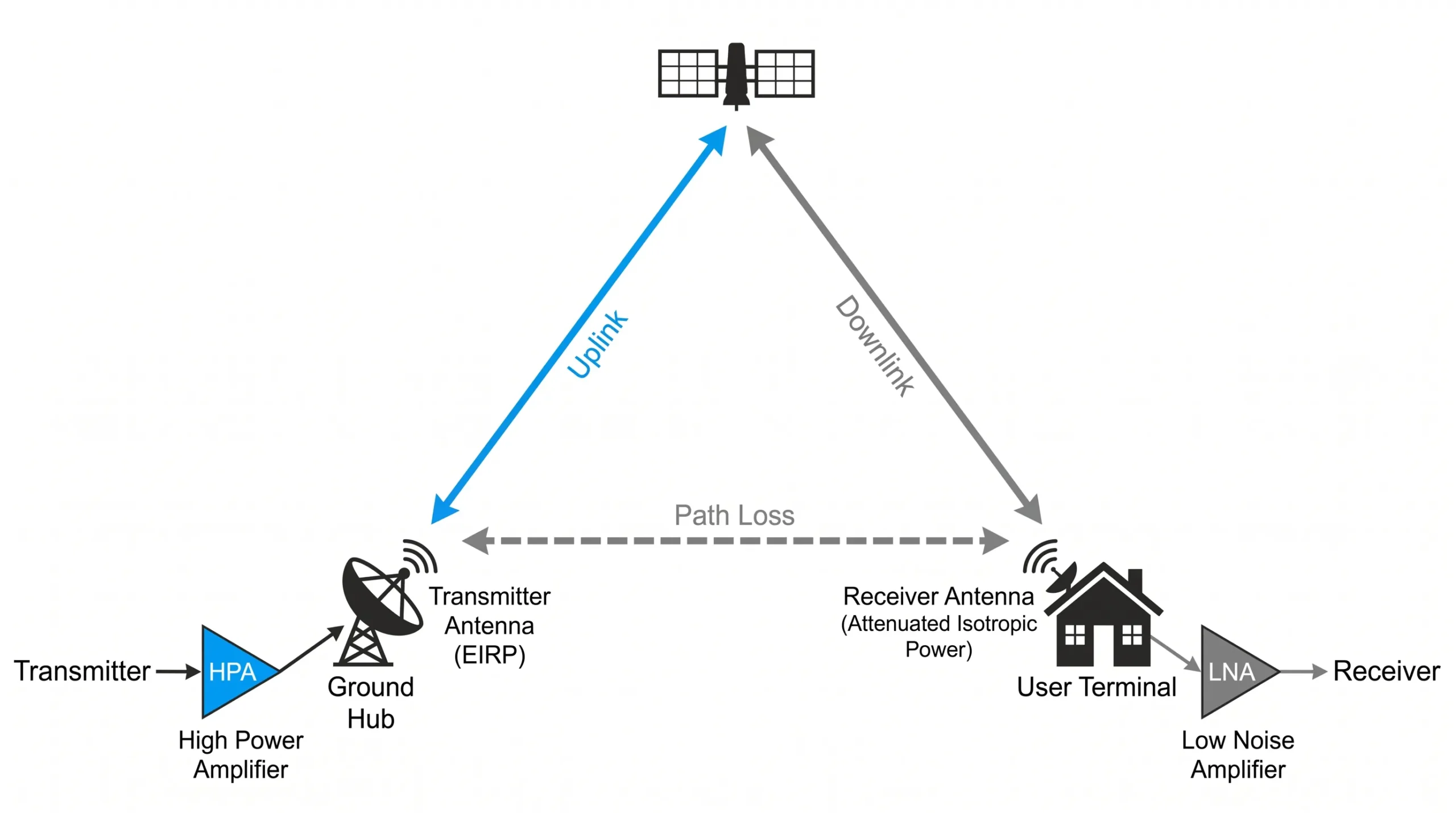
Satellite signals are weak because they travel over 36,000 kilometers from a geostationary orbit1. This massive distance causes the signal to spread out and lose almost all its power. By the time it reaches Earth, it is a mere whisper, easily drowned out by noise.
The Long Journey from Space
The primary reason for signal weakness is something called free-space path loss (FSPL)2. Think of a lightbulb. The farther away you are, the dimmer it looks. The same principle applies to radio waves. The signal energy spreads out over a massive area as it travels from the satellite. The power received is inversely proportional to the square of the distance. Given the 36,000 km journey, the loss is enormous. The satellite's transmitter power is also limited, so it can't just shout louder to overcome this distance.
Battling the Atmosphere
The signal's journey isn't over once it reaches the atmosphere. It still has to fight its way through clouds, rain, and even the air itself. Water vapor and oxygen absorb radio frequency energy. This effect, known as atmospheric attenuation3, gets much worse during heavy rain, a problem engineers call "rain fade4".
| Factor | Impact on Signal |
|---|---|
| Free-Space Path Loss | The largest source of signal loss. |
| Atmospheric Absorption | Constant, minor loss from air and water vapor. |
| Rain Fade | Significant, temporary loss during bad weather. |
All these factors combine to deliver a signal to your dish that is billions of times weaker than when it left the satellite5.
How does a parabolic dish solve this problem?
A weak signal is a useless signal. If you can't collect enough of it, you get nothing but static. The parabolic dish is the elegant, time-tested solution to this problem.
A parabolic dish acts as a signal collector and concentrator. Its specific curved shape reflects all incoming parallel waves from the satellite to a single point, the focal point. This process gathers the faint energy from a large area and focuses it, dramatically boosting signal strength.

The Magic of the Parabola
The geometric shape of the dish is a parabola for a very specific reason. Any wave that hits the surface of the dish reflects at an angle that directs it precisely to the focal point6. This is where the LNB's feedhorn is placed. The dish effectively funnels all the signal energy it collects into the LNB. My mentor once explained it perfectly. He said the signal is like a whisper in a huge stadium. The dish is like cupping your hands behind your ear. It doesn't make the whisper louder, but it gathers more of it and directs it right where it needs to go.
Gain: Bigger is Better
This ability to concentrate energy is called antenna gain. The bigger the dish, the more signal it can collect, and the higher its gain. Gain is a measure of how well the antenna converts widespread signal energy into a concentrated beam.
| Dish Diameter | cURL Too many subrequests by single Worker invocation. To configure this limit, refer to https://developers.cloudflare.com/workers/wrangler/configuration/#limits | cURL Too many subrequests by single Worker invocation. To configure this limit, refer to https://developers.cloudflare.com/workers/wrangler/configuration/#limits |
|---|---|---|
| cURL Too many subrequests by single Worker invocation. To configure this limit, refer to https://developers.cloudflare.com/workers/wrangler/configuration/#limits | cURL Too many subrequests by single Worker invocation. To configure this limit, refer to https://developers.cloudflare.com/workers/wrangler/configuration/#limits | cURL Too many subrequests by single Worker invocation. To configure this limit, refer to https://developers.cloudflare.com/workers/wrangler/configuration/#limits |
| cURL Too many subrequests by single Worker invocation. To configure this limit, refer to https://developers.cloudflare.com/workers/wrangler/configuration/#limits | cURL Too many subrequests by single Worker invocation. To configure this limit, refer to https://developers.cloudflare.com/workers/wrangler/configuration/#limits | cURL Too many subrequests by single Worker invocation. To configure this limit, refer to https://developers.cloudflare.com/workers/wrangler/configuration/#limits |
| cURL Too many subrequests by single Worker invocation. To configure this limit, refer to https://developers.cloudflare.com/workers/wrangler/configuration/#limits | cURL Too many subrequests by single Worker invocation. To configure this limit, refer to https://developers.cloudflare.com/workers/wrangler/configuration/#limits | cURL Too many subrequests by single Worker invocation. To configure this limit, refer to https://developers.cloudflare.com/workers/wrangler/configuration/#limits |
cURL Too many subrequests by single Worker invocation. To configure this limit, refer to https://developers.cloudflare.com/workers/wrangler/configuration/#limits.
cURL Too many subrequests by single Worker invocation. To configure this limit, refer to https://developers.cloudflare.com/workers/wrangler/configuration/#limits
cURL Too many subrequests by single Worker invocation. To configure this limit, refer to https://developers.cloudflare.com/workers/wrangler/configuration/#limits.
cURL Too many subrequests by single Worker invocation. To configure this limit, refer to https://developers.cloudflare.com/workers/wrangler/configuration/#limits cURL Too many subrequests by single Worker invocation. To configure this limit, refer to https://developers.cloudflare.com/workers/wrangler/configuration/#limits7, cURL Too many subrequests by single Worker invocation. To configure this limit, refer to https://developers.cloudflare.com/workers/wrangler/configuration/#limits.

cURL Too many subrequests by single Worker invocation. To configure this limit, refer to https://developers.cloudflare.com/workers/wrangler/configuration/#limits
cURL Too many subrequests by single Worker invocation. To configure this limit, refer to https://developers.cloudflare.com/workers/wrangler/configuration/#limits cURL Too many subrequests by single Worker invocation. To configure this limit, refer to https://developers.cloudflare.com/workers/wrangler/configuration/#limits8, cURL Too many subrequests by single Worker invocation. To configure this limit, refer to https://developers.cloudflare.com/workers/wrangler/configuration/#limits.
cURL Too many subrequests by single Worker invocation. To configure this limit, refer to https://developers.cloudflare.com/workers/wrangler/configuration/#limits
Satellite signals are in very high-frequency bands, like the Ku-band (around 12 GHz). These high frequencies are great for carrying lots of information but terrible at traveling through cables. They lose power very quickly. The LNB solves this by "block downconverting" the entire band of frequencies to a lower range, called the L-band (around 1-2 GHz). This lower intermediate frequency (IF) travels through coaxial cable with very little loss.
| Frequency Band | 名前 | Use Case |
|---|---|---|
| 10.7 - 12.75 GHz | Ku-Band9 | Original Satellite Signal |
| 950 - 2150 MHz | L-Band | Downconverted Signal for Cable |
The LNB's job is to take the focused signal from the dish, amplify it cleanly, and then translate it to a language the cable and receiver can understand.
How do we ensure an LNB design is perfect before building it?
Designing an LNB is a complex balancing act. A small error in the design can ruin performance. Building physical prototypes is expensive and slow. That is why we use powerful simulation tools.
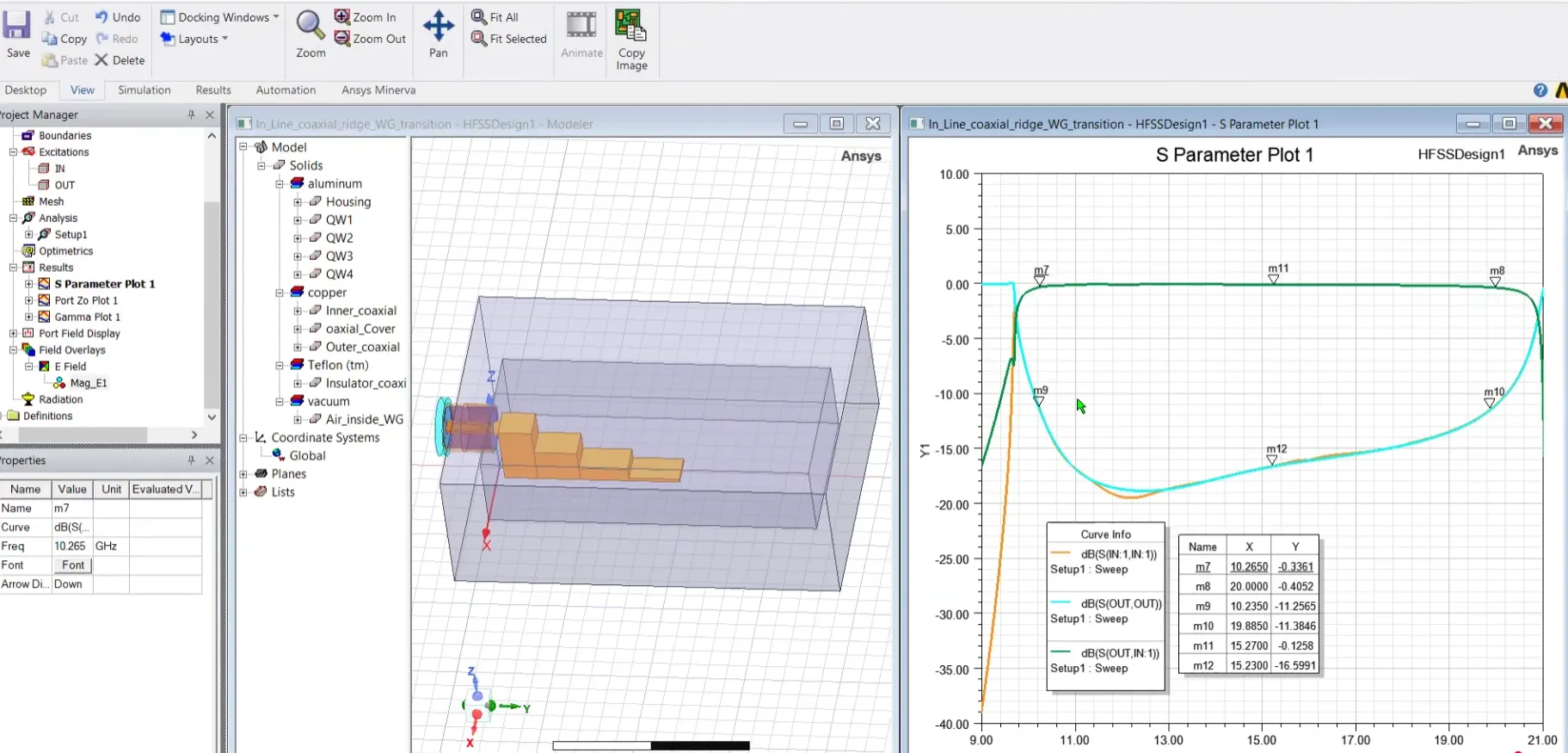
Before manufacturing, we validate LNB designs using advanced computer simulation software. These tools model the complete electromagnetic behavior of the LNB. This allows our engineers to perfect the feedhorn shape, LNA circuit, and downconverter for the best possible real-world performance.
Virtual Prototyping
Software like CST Studio Suite or Ansys HFSS10 allows us to create a 3D model of the LNB and simulate how electromagnetic waves interact with it. We can see exactly how the feedhorn will perform and how the circuit board traces will behave at gigahertz frequencies. This is our virtual test bench. We can test hundreds of variations of a design in software without ever touching a soldering iron. This process, known as virtual prototyping11, is a core part of our engineering platform. It dramatically speeds up development and reduces costly mistakes.
Optimizing for Peak Performance
With these simulation tools, we can fine-tune every aspect of the LNB. We can adjust the shape of the feedhorn for optimal illumination of the dish, ensuring no signal is wasted. We can perfect the impedance matching between the antenna, the LNA, and the mixer to maximize power transfer and minimize reflections. We can analyze the stability of the LNA to prevent unwanted oscillations. This meticulous optimization process ensures that when we do build the first physical unit, it works exactly as intended, delivering the stable, reliable performance our clients expect.
結論
In short, the dish and LNB are a team. The dish gathers and focuses the faint signal, and the LNB cleanly amplifies and converts it. Neither can do the job alone.
"Why is geostationary orbit for a satellite fixed at about 36000 km ...", https://www.reddit.com/r/askscience/comments/3d3v0e/why_is_geostationary_orbit_for_a_satellite_fixed/. Sources such as NASA or the European Space Agency define a geostationary orbit as a specific type of geosynchronous orbit directly above the Earth's equator with a characteristic altitude of approximately 35,786 kilometers (about 22,236 miles). Evidence role: definition; source type: encyclopedia. Supports: The claim that geostationary orbit is at an altitude of approximately 36,000 kilometers (more precisely, 35,786 km) above Earth's equator.. ↩
"Free-space path loss - Wikipedia", https://en.wikipedia.org/wiki/Free-space_path_loss. Engineering and physics resources define free-space path loss as the attenuation of radio energy that occurs as a signal propagates through a line-of-sight path in free space, with the loss being proportional to the square of the distance between the transmitter and receiver. Evidence role: definition; source type: education. Supports: The definition of Free-Space Path Loss (FSPL) and its basis in the inverse-square law for electromagnetic radiation.. ↩
"Oxygen and water vapor absorption of radio waves in the atmosphere", https://link.springer.com/article/10.1007/BF01988856. Studies on radio wave propagation confirm that atmospheric gases cause signal attenuation, with notable absorption peaks for water vapor and oxygen at specific frequencies, including those in and around the Ku-band used for satellite communication. Evidence role: mechanism; source type: paper. Supports: The mechanism by which atmospheric gases, particularly oxygen and water vapor, absorb energy from radio waves, causing signal attenuation.. ↩
"Rain fade - Wikipedia", https://en.wikipedia.org/wiki/Rain_fade. Telecommunication standards bodies and research institutions define rain fade as the absorption and scattering of microwave radio frequency signals by rain, which causes significant signal degradation, particularly for frequencies above 10 GHz. Evidence role: definition; source type: institution. Supports: The definition of 'rain fade' and its significant impact on higher-frequency satellite signals.. ↩
"[PDF] Satellite Link Budget - ITSO.int", https://itso.int/wp-content/uploads/2018/04/LBA-1.pdf. A typical link budget analysis for a geostationary satellite operating in the Ku-band shows a free-space path loss of approximately 205-207 dB, which corresponds to a power reduction factor far greater than one billion. Evidence role: statistic; source type: paper. Supports: The typical magnitude of signal loss for a geostationary satellite link.. Scope note: The exact value depends on specific frequency, distance, and atmospheric conditions, but the cited value supports the general order of magnitude. ↩
"Parabolic reflector - Wikipedia", https://en.wikipedia.org/wiki/Parabolic_reflector. Physics and mathematics texts explain that the defining geometric property of a parabola is that it reflects all incident rays parallel to its axis of symmetry to a single point, known as the focal point, making it an ideal shape for a reflector antenna. Evidence role: mechanism; source type: encyclopedia. Supports: The geometric property of a parabola that causes all rays parallel to its axis of symmetry to reflect and converge at a single focal point.. ↩
"Low-noise block downconverter - Wikipedia", https://en.wikipedia.org/wiki/Low-noise_block_downconverter. Technical glossaries and telecommunications literature define a Low-Noise Block downconverter (LNB) as the receiving device on a satellite dish that collects radio waves, amplifies them with a low-noise amplifier, and downconverts the block of high frequencies to a lower block of intermediate frequencies (IF). Evidence role: definition; source type: encyclopedia. Supports: The definition of an LNB as a device that amplifies a block of frequencies and converts them to a lower frequency block.. ↩
"LNB (Low Noise Block Converter) Noise Figure and Selection Guide", https://antesky.com/lnb-low-noise-block-converter-noise-figure-and-selection-guide/. Datasheets for commercially available high-performance LNBs for the Ku-band confirm that noise figures of 0.5 dB and lower are achievable with modern semiconductor technology, representing a common benchmark for quality consumer and professional-grade equipment. Evidence role: case_reference; source type: other. Supports: The technical feasibility of manufacturing LNBs with noise figures as low as 0.5 dB.. Scope note: This performance level is characteristic of high-quality LNBs and may not be representative of all products on the market. ↩
"Ku band - Wikipedia", https://en.wikipedia.org/wiki/Ku_band. Frequency allocation tables from regulatory bodies like the International Telecommunication Union (ITU) define the Ku-band for satellite services, which includes the 10.7 to 12.75 GHz range, and industry standards specify the 950 to 2150 MHz range as the L-band for satellite intermediate frequencies. Evidence role: definition; source type: government. Supports: The standardized frequency ranges for the Ku-band used in satellite communications and the L-band used as the intermediate frequency.. ↩
"[PDF] Getting Started with HFSS™ A Ridged Horn Antenna", https://arbabianwiki.stanford.edu/uploads/c/c2/Transienthornantenna.pdf. Academic papers in microwave engineering frequently document the use of full-wave electromagnetic simulation software, such as Ansys HFSS and CST Studio Suite, for the design, analysis, and virtual prototyping of microwave components, including LNB feedhorns and circuits. Evidence role: general_support; source type: paper. Supports: The use of computational electromagnetic simulation software is a standard practice in the design and optimization of microwave components like antennas and LNBs.. Scope note: The source would support the general methodology rather than the specific company's use of the software. ↩
"Virtual prototyping - Wikipedia", https://en.wikipedia.org/wiki/Virtual_prototyping. Engineering design literature defines virtual prototyping as a method where a digital model of a product is created and tested in a simulated environment to evaluate its form, fit, and function, thereby reducing the need for costly and time-consuming physical prototypes. Evidence role: definition; source type: education. Supports: The definition of virtual prototyping as a method using computer-aided engineering and simulation to validate a design before creating a physical model.. ↩

 Japanese
  English
  Spanish
  French
  Arabic
  Vietnamese
  Indonesian
  Hindi
Hindi  Danish
  Bulgarian