
Torn between compact antenna size and raw BUC power? That compromise doesn't just degrade signal—it costs you contracts and cuts into your margins.
Matching BUC power with antenna size requires a precise RF link budget. Calculate your required EIRP, factor in the antenna gain (tied to its size), and select a BUC with enough power to overcome path loss, while staying within its linear operating range.
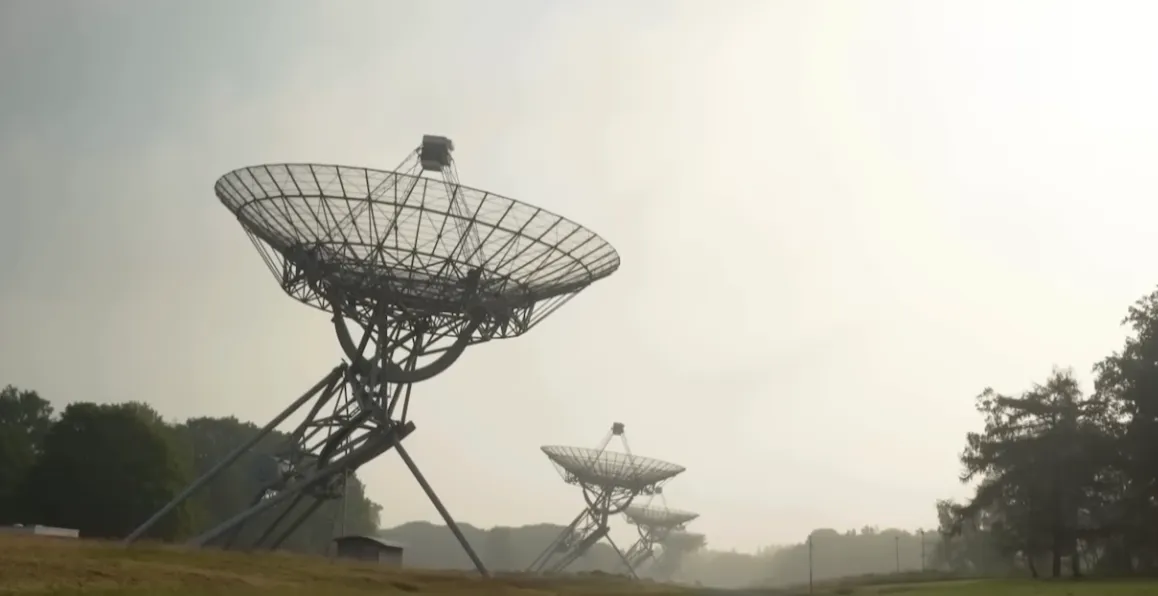
I recently had a conversation that many of you might find familiar. A client came to me with a request. "We need to shrink our antenna from 1.2 meters to 0.6 meters to cut costs," he said. "Can you just tweak some software parameters? We want to keep the same BUC." I had to explain that RF engineering isn't magic. The relationship between an antenna and a BUC is a system governed by strict rules. Let’s break down why this is so critical.
Why Can’t You Just Halve the Antenna Size and Keep the Same BUC?
Thinking of shrinking your antenna to save costs without changing your BUC? This decision can severely degrade your link performance, leading to connection failures and data loss.
Halving the antenna diameter reduces its gain by 6 dB1. If you keep the same BUC, your total radiated power (EIRP) drops significantly. This makes your signal much weaker, likely falling below the threshold needed for a stable connection, especially in adverse weather conditions.
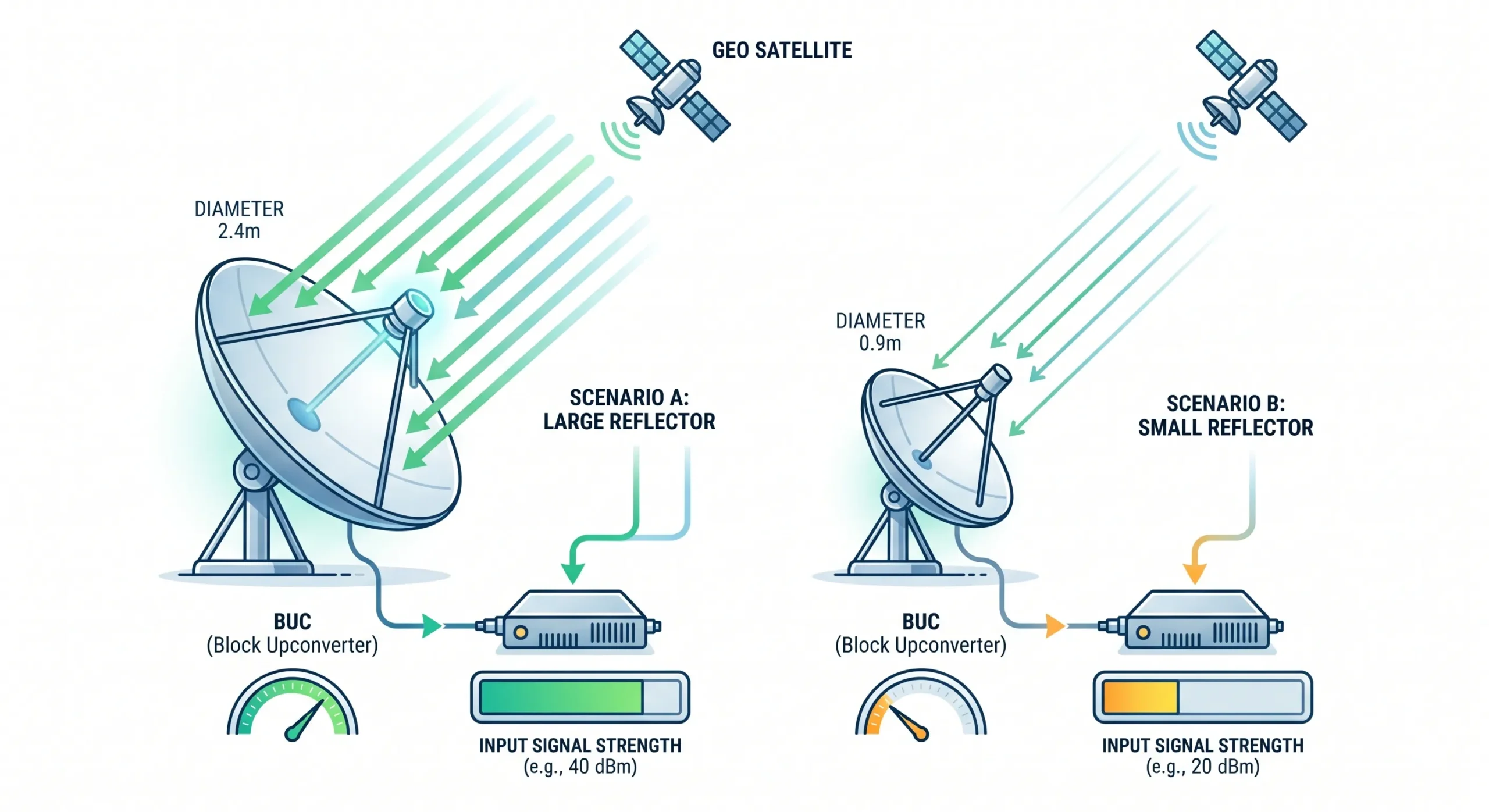
The relationship between an antenna's size and its gain is fundamental. Antenna gain is directly proportional to its effective aperture area2. When you reduce the diameter of a parabolic antenna by half, you are actually reducing its area by a factor of four. This translates to a significant loss in gain.
The Math Behind the Gain Loss
The formula for antenna gain is approximately [Gain (dB) ≈ 10 * log10(η * (πD/λ)^2)](https://en.wikipedia.org/wiki/Parabolic_antenna)3, where D is the diameter. A quick rule of thumb is that halving the diameter (D) results in a 6 dB loss of gain.
Let's see what that means for the system's EIRP (Effective Isotropic Radiated Power).
| Component | Original System (1.2m) | New System (0.6m) | Impact |
|---|---|---|---|
| Antenna Gain | G (dBi) | G - 6 dB | -6 dB |
| BUC Power | P (dBW) | P (dBW) | No Change |
| System EIRP | P + G (dBW) | P + G - 6 (dBW) | -6 dB |
A 6 dB drop in your link budget is massive. It could be the entire rain fade margin you designed for4, meaning your link will fail during the slightest drizzle. It's a system problem that requires a hardware solution, not a simple software fix.
How Do You Calculate the Right BUC Power for Your Antenna?
Are you unsure how much BUC power you truly need? Guessing can lead to overspending on overpowered units or suffering from an underperforming link. It’s a costly mistake.
Start with the satellite's required power density at its location. Work backward through your link budget, adding margins for free space loss, atmospheric absorption, and rain fade. The result tells you the required EIRP. Then, you can trade off between antenna gain and BUC power.
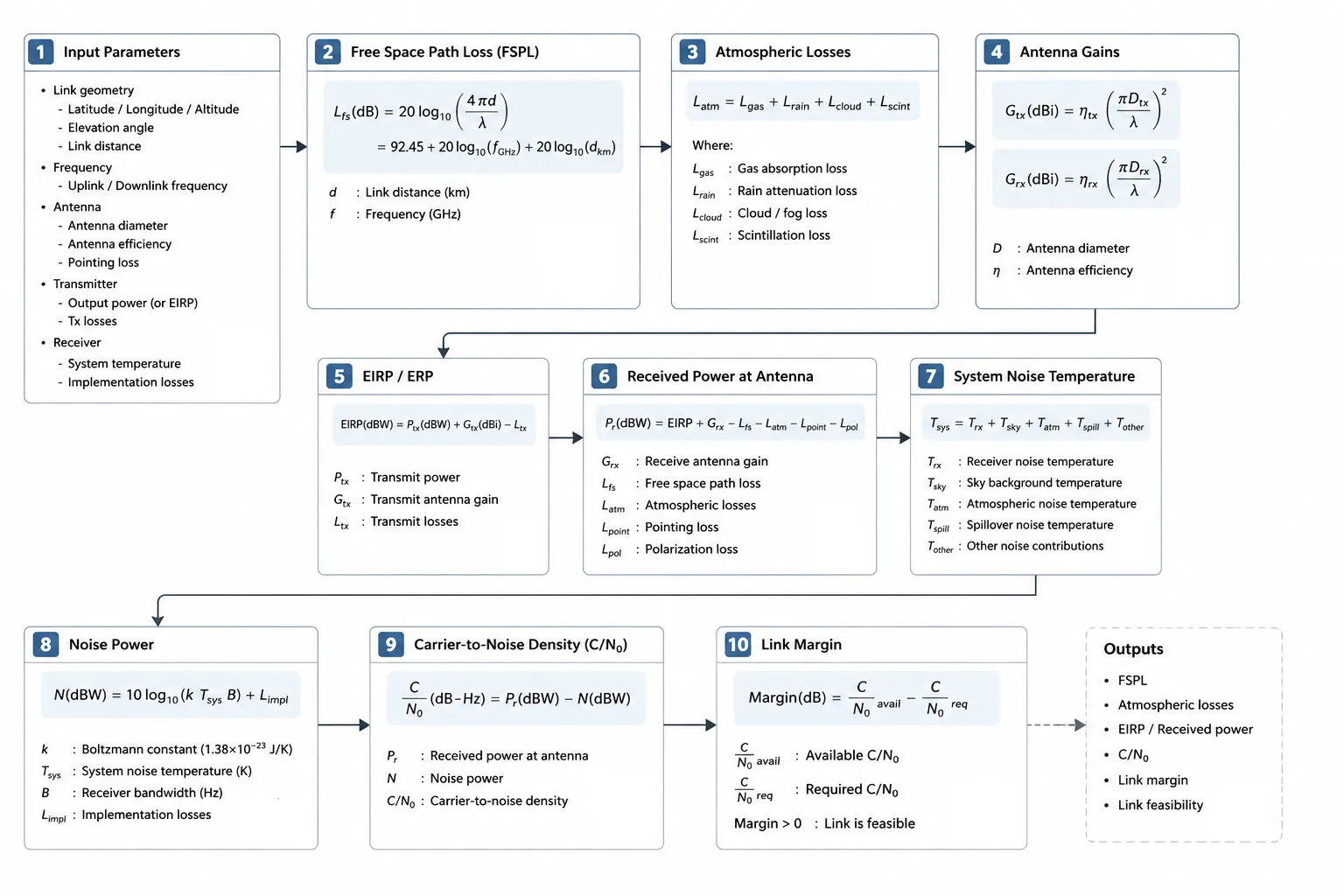
The core of this process is the RF link budget. It’s a simple accounting of all the gains and losses in your signal path from the transmitter to the receiver. The goal is to ensure the received signal power is above the receiver's sensitivity threshold with a healthy margin.
cURL Too many subrequests by single Worker invocation. To configure this limit, refer to https://developers.cloudflare.com/workers/wrangler/configuration/#limits
cURL Too many subrequests by single Worker invocation. To configure this limit, refer to https://developers.cloudflare.com/workers/wrangler/configuration/#limits
- cURL Too many subrequests by single Worker invocation. To configure this limit, refer to https://developers.cloudflare.com/workers/wrangler/configuration/#limits cURL Too many subrequests by single Worker invocation. To configure this limit, refer to https://developers.cloudflare.com/workers/wrangler/configuration/#limits.
- cURL Too many subrequests by single Worker invocation. To configure this limit, refer to https://developers.cloudflare.com/workers/wrangler/configuration/#limits cURL Too many subrequests by single Worker invocation. To configure this limit, refer to https://developers.cloudflare.com/workers/wrangler/configuration/#limits.
- cURL Too many subrequests by single Worker invocation. To configure this limit, refer to https://developers.cloudflare.com/workers/wrangler/configuration/#limits cURL Too many subrequests by single Worker invocation. To configure this limit, refer to https://developers.cloudflare.com/workers/wrangler/configuration/#limits.
| Thông số | cURL Too many subrequests by single Worker invocation. To configure this limit, refer to https://developers.cloudflare.com/workers/wrangler/configuration/#limits | cURL Too many subrequests by single Worker invocation. To configure this limit, refer to https://developers.cloudflare.com/workers/wrangler/configuration/#limits |
|---|---|---|
| cURL Too many subrequests by single Worker invocation. To configure this limit, refer to https://developers.cloudflare.com/workers/wrangler/configuration/#limits | cURL Too many subrequests by single Worker invocation. To configure this limit, refer to https://developers.cloudflare.com/workers/wrangler/configuration/#limits | cURL Too many subrequests by single Worker invocation. To configure this limit, refer to https://developers.cloudflare.com/workers/wrangler/configuration/#limits |
| cURL Too many subrequests by single Worker invocation. To configure this limit, refer to https://developers.cloudflare.com/workers/wrangler/configuration/#limits5 | cURL Too many subrequests by single Worker invocation. To configure this limit, refer to https://developers.cloudflare.com/workers/wrangler/configuration/#limits | cURL Too many subrequests by single Worker invocation. To configure this limit, refer to https://developers.cloudflare.com/workers/wrangler/configuration/#limits |
| cURL Too many subrequests by single Worker invocation. To configure this limit, refer to https://developers.cloudflare.com/workers/wrangler/configuration/#limits | cURL Too many subrequests by single Worker invocation. To configure this limit, refer to https://developers.cloudflare.com/workers/wrangler/configuration/#limits | cURL Too many subrequests by single Worker invocation. To configure this limit, refer to https://developers.cloudflare.com/workers/wrangler/configuration/#limits |
| cURL Too many subrequests by single Worker invocation. To configure this limit, refer to https://developers.cloudflare.com/workers/wrangler/configuration/#limits | cURL Too many subrequests by single Worker invocation. To configure this limit, refer to https://developers.cloudflare.com/workers/wrangler/configuration/#limits | (-90 + 205 + 5) |
cURL Too many subrequests by single Worker invocation. To configure this limit, refer to https://developers.cloudflare.com/workers/wrangler/configuration/#limits 120 - 42 = 78 dBW of power. A smaller 0.6m antenna with 36 dBi gain would need a BUC with 120 - 36 = 84 dBW of power. That's four times the power!
Why Does Signal Modulation Affect Your BUC Power Choice?
You've calculated your required power, but your link is still unstable. The problem might be signal modulation causing non-linear distortion, creating errors and wasting power.
Modern, high-data-rate modulations have a high Peak-to-Average Power Ratio (PAPR)6. Driving your BUC too close to its maximum (saturated) power can clip these peaks, causing distortion and tăng phổ7. You must back off the power to ensure the BUC operates in its linear region.

A BUC is a power amplifier, and not all power is created equal. Amplifiers have a linear region where the output is a faithful, magnified copy of the input. They also have a saturated region where they can't produce any more power. Pushing an amplifier into saturation clips the signal.
Understanding PAPR and Back-off
Simple modulations like BPSK have a low PAPR. But complex, higher-order modulations like 16QAM or 64QAM, used for high-speed data, have high peaks in their waveform. The ratio of these peaks to the average power is the PAPR.
If your average power is set too high, these peaks will push the BUC into saturation.
| Modulation Scheme | Typical PAPR | Required Power Back-off | Consequence of No Back-off |
|---|---|---|---|
| QPSK | ~3-4 dB | 2-3 dB | Minor distortion |
| 16QAM | ~5-7 dB8 | 4-5 dB | Significant bit errors, spectral regrowth |
| 64QAM | ~7-9 dB | 6-7 dB9 | Unusable link, interference with adjacent channels |
This means if you need 10W of linear power for your 16QAM signal, you can't just buy a 10W BUC. You need a BUC rated for much higher saturated power, perhaps 25W or 40W, and then "back it off" to operate at 10W average power. This ensures even the highest peaks are amplified cleanly. Ignoring this is a classic mistake that leads to unstable links.
How Can You Get More Power Without Compromising Linearity?
Need more power but worried about distortion and size? Standard BUCs force you to choose between high power and clean signals, limiting your system's performance and flexibility.
Advanced BUCs, like our 3000W saturated power amplifier, are designed for high efficiency and linearity. They provide the headroom needed for complex modulations and allow you to use smaller antennas while maintaining a robust link margin, even in challenging conditions.

As we've seen, matching BUC power and antenna size is a delicate balance involving physics and budget. My company, Safari Microwave, specializes in creating components that give you more flexibility in this balancing act. For over 30 years, our engineering team has been designing and perfecting RF components for demanding applications.
The Safari Microwave Advantage
Take the scenario with the smaller antenna. Instead of being stuck, you need a BUC with more linear power. Our product line is designed for exactly these challenges.
- High Power for Smaller Antennas: cURL Too many subrequests by single Worker invocation. To configure this limit, refer to https://developers.cloudflare.com/workers/wrangler/configuration/#limits.
- cURL Too many subrequests by single Worker invocation. To configure this limit, refer to https://developers.cloudflare.com/workers/wrangler/configuration/#limits cURL Too many subrequests by single Worker invocation. To configure this limit, refer to https://developers.cloudflare.com/workers/wrangler/configuration/#limits.
- cURL Too many subrequests by single Worker invocation. To configure this limit, refer to https://developers.cloudflare.com/workers/wrangler/configuration/#limits cURL Too many subrequests by single Worker invocation. To configure this limit, refer to https://developers.cloudflare.com/workers/wrangler/configuration/#limits.
Kết luận
cURL Too many subrequests by single Worker invocation. To configure this limit, refer to https://developers.cloudflare.com/workers/wrangler/configuration/#limits.
"cURL Too many subrequests by single Worker invocation. To configure this limit, refer to https://developers.cloudflare.com/workers/wrangler/configuration/#limits. ↩
"cURL Too many subrequests by single Worker invocation. To configure this limit, refer to https://developers.cloudflare.com/workers/wrangler/configuration/#limits. ↩
"cURL Too many subrequests by single Worker invocation. To configure this limit, refer to https://developers.cloudflare.com/workers/wrangler/configuration/#limits. ↩
"cURL Too many subrequests by single Worker invocation. To configure this limit, refer to https://developers.cloudflare.com/workers/wrangler/configuration/#limits. ↩
"cURL Too many subrequests by single Worker invocation. To configure this limit, refer to https://developers.cloudflare.com/workers/wrangler/configuration/#limits. ↩
"cURL Too many subrequests by single Worker invocation. To configure this limit, refer to https://developers.cloudflare.com/workers/wrangler/configuration/#limits. ↩
"cURL Too many subrequests by single Worker invocation. To configure this limit, refer to https://developers.cloudflare.com/workers/wrangler/configuration/#limits. ↩
"cURL Too many subrequests by single Worker invocation. To configure this limit, refer to https://developers.cloudflare.com/workers/wrangler/configuration/#limits. ↩
"cURL Too many subrequests by single Worker invocation. To configure this limit, refer to https://developers.cloudflare.com/workers/wrangler/configuration/#limits. ↩

 Vietnamese
  English
  Spanish
  French
  Japanese
  Arabic
  Indonesian
  Hindi
Hindi  Danish
  Bulgarian