
You trust the datasheet for amplifier efficiency. But your real-world SSPA design overheats and performs poorly. I will show you how to measure the real efficiency and avoid these problems.
To accurately determine RF power amplifier efficiency, you must go beyond the datasheet. Use a high-precision digital multimeter and a calibrated power meter. De-embed your test setup using S2P files. And most importantly, test with realistic modulated signals using a 3-5dB power back-off.

Datasheet numbers are a great starting point, but they are far from the whole story. They represent an ideal world that rarely exists in a final product. Understanding the gap between the datasheet and reality is the first step toward a successful design. Let's break down why those numbers can be misleading and what you can do to get the true performance of your power amplifier.
Why are datasheet efficiency numbers often misleading?
You design an SSPA based on a datasheet's peak efficiency. But the prototype gets too hot and its ACPR is terrible. You wonder what went wrong. The problem is the gap between ideal test conditions and the real world.
Datasheets usually list efficiency under continuous wave (CW) saturation. This is a best-case scenario. Real applications use complex modulated signals. These signals have different power characteristics. They push the amplifier into different operating regions and significantly lower the practical efficiency you will actually get.

Datasheet specifications are measured in a highly controlled lab environment. This is often not how the amplifier will be used. The biggest difference comes from the test signal itself. Datasheets use a simple, single-frequency continuous wave (CW) signal to push the amplifier to its saturation point. This is where it's most efficient. But modern communication systems use complex modulation schemes like QAM or OFDM. These signals have a high Peak-to-Average Power Ratio (PAPR).1 If you operate the amplifier near saturation, the signal peaks will be clipped. This causes distortion and poor signal quality, measured by metrics like ACPR or EVM.2 To avoid this, you must "back off" the average power, forcing the amplifier to operate in a more linear, but less efficient, region. At Safari Microwave, when we design our high-power SSPAs, like our 3000W SSPA, we find that real-world efficiency can be 10-20% lower than the datasheet CW efficiency. This is a huge difference that directly impacts thermal design and operational cost.
| パラメータ | Datasheet Condition (Ideal) | Real-World Condition (Practical) |
|---|---|---|
| Signal Type | Continuous Wave (CW) | Modulated (QAM, OFDM, etc.) |
| Operating Point | Saturation (Peak Efficiency) | Backed-off (Linear Region) |
| PAPR | 0 dB | 6-12 dB or higher |
| Focus Metric | Peak Saturated Power, CW Efficiency | Linearity (ACPR/EVM), Efficiency at Back-off |
What are the key metrics for amplifier efficiency?
You hear engineers talk about Drain Efficiency and PAE. It can be confusing to know which one matters more for your specific design goals. Let's make these two critical metrics clear so you can use them effectively.
Drain Efficiency (DE) shows how well DC power is converted to RF output power. But Power Added Efficiency (PAE) is often more useful. It also accounts for the RF input power needed to drive the amplifier. PAE shows the net power added, making it a better indicator for system efficiency.
| Comparison Dimension | Drain Efficiency (DE) | 電力付加効率(PAE) |
|---|---|---|
| Physical Meaning | Absolute conversion efficiency from DC to RF | Efficiency of the net signal power added by the system |
| Input Impact | Ignores input drive power; considers output only | Subtracts input power; better reflects actual gain requirements |
| Numerical Value | Always greater than PAE | cURL Too many subrequests by single Worker invocation. To configure this limit, refer to https://developers.cloudflare.com/workers/wrangler/configuration/#limits |
| cURL Too many subrequests by single Worker invocation. To configure this limit, refer to https://developers.cloudflare.com/workers/wrangler/configuration/#limits | cURL Too many subrequests by single Worker invocation. To configure this limit, refer to https://developers.cloudflare.com/workers/wrangler/configuration/#limits. | cURL Too many subrequests by single Worker invocation. To configure this limit, refer to https://developers.cloudflare.com/workers/wrangler/configuration/#limits |
cURL Too many subrequests by single Worker invocation. To configure this limit, refer to https://developers.cloudflare.com/workers/wrangler/configuration/#limits.
cURL Too many subrequests by single Worker invocation. To configure this limit, refer to https://developers.cloudflare.com/workers/wrangler/configuration/#limits
cURL Too many subrequests by single Worker invocation. To configure this limit, refer to https://developers.cloudflare.com/workers/wrangler/configuration/#limits
cURL Too many subrequests by single Worker invocation. To configure this limit, refer to https://developers.cloudflare.com/workers/wrangler/configuration/#limits
cURL Too many subrequests by single Worker invocation. To configure this limit, refer to https://developers.cloudflare.com/workers/wrangler/configuration/#limits3
cURL Too many subrequests by single Worker invocation. To configure this limit, refer to https://developers.cloudflare.com/workers/wrangler/configuration/#limits, cURL Too many subrequests by single Worker invocation. To configure this limit, refer to https://developers.cloudflare.com/workers/wrangler/configuration/#limits cURL Too many subrequests by single Worker invocation. To configure this limit, refer to https://developers.cloudflare.com/workers/wrangler/configuration/#limits, cURL Too many subrequests by single Worker invocation. To configure this limit, refer to https://developers.cloudflare.com/workers/wrangler/configuration/#limits cURL Too many subrequests by single Worker invocation. To configure this limit, refer to https://developers.cloudflare.com/workers/wrangler/configuration/#limits cURL Too many subrequests by single Worker invocation. To configure this limit, refer to https://developers.cloudflare.com/workers/wrangler/configuration/#limits cURL Too many subrequests by single Worker invocation. To configure this limit, refer to https://developers.cloudflare.com/workers/wrangler/configuration/#limits.
cURL Too many subrequests by single Worker invocation. To configure this limit, refer to https://developers.cloudflare.com/workers/wrangler/configuration/#limits.
What equipment do you need for accurate measurements?
cURL Too many subrequests by single Worker invocation. To configure this limit, refer to https://developers.cloudflare.com/workers/wrangler/configuration/#limits.
cURL Too many subrequests by single Worker invocation. To configure this limit, refer to https://developers.cloudflare.com/workers/wrangler/configuration/#limits. cURL Too many subrequests by single Worker invocation. To configure this limit, refer to https://developers.cloudflare.com/workers/wrangler/configuration/#limits.4

cURL Too many subrequests by single Worker invocation. To configure this limit, refer to https://developers.cloudflare.com/workers/wrangler/configuration/#limits.
cURL Too many subrequests by single Worker invocation. To configure this limit, refer to https://developers.cloudflare.com/workers/wrangler/configuration/#limitsP_dc = Vds * Ids) will be magnified in the final efficiency number. I once spent a week trying to figure out why my PAE was so low. I blamed the transistor and the matching network. It turned out the lab's general-purpose multimeter was off by 50mA. I swapped it for a calibrated Keithley DMM and the efficiency was right where it should be.
Second, a calibrated power meter and sensor. A spectrum analyzer is great for looking at signals and measuring relative power. But it is not a tool for accurate absolute power measurement. A dedicated power meter is the standard. Use one with a resolution of 0.01dB. This lets you see small changes in gain and output power, especially when characterizing the amplifier's compression point. This level of precision is essential for all our products, from our ultra-low noise LNAs to our high-power PIN diode switches.
How do you set up the test to get real-world results?
You have the right equipment, but your numbers still don't match the final product's performance. This is because your test bench itself adds losses and does not reflect the actual use case. A proper test setup involves de-embedding and using realistic signals.
First, characterize the losses of your test cables, couplers, and fixtures. Save this as an S2P file. Then, use de-embedding in your software to remove these effects. After that, use a modulated signal, not a CW tone, and back off the average input power by 3-5dB from the compression point.
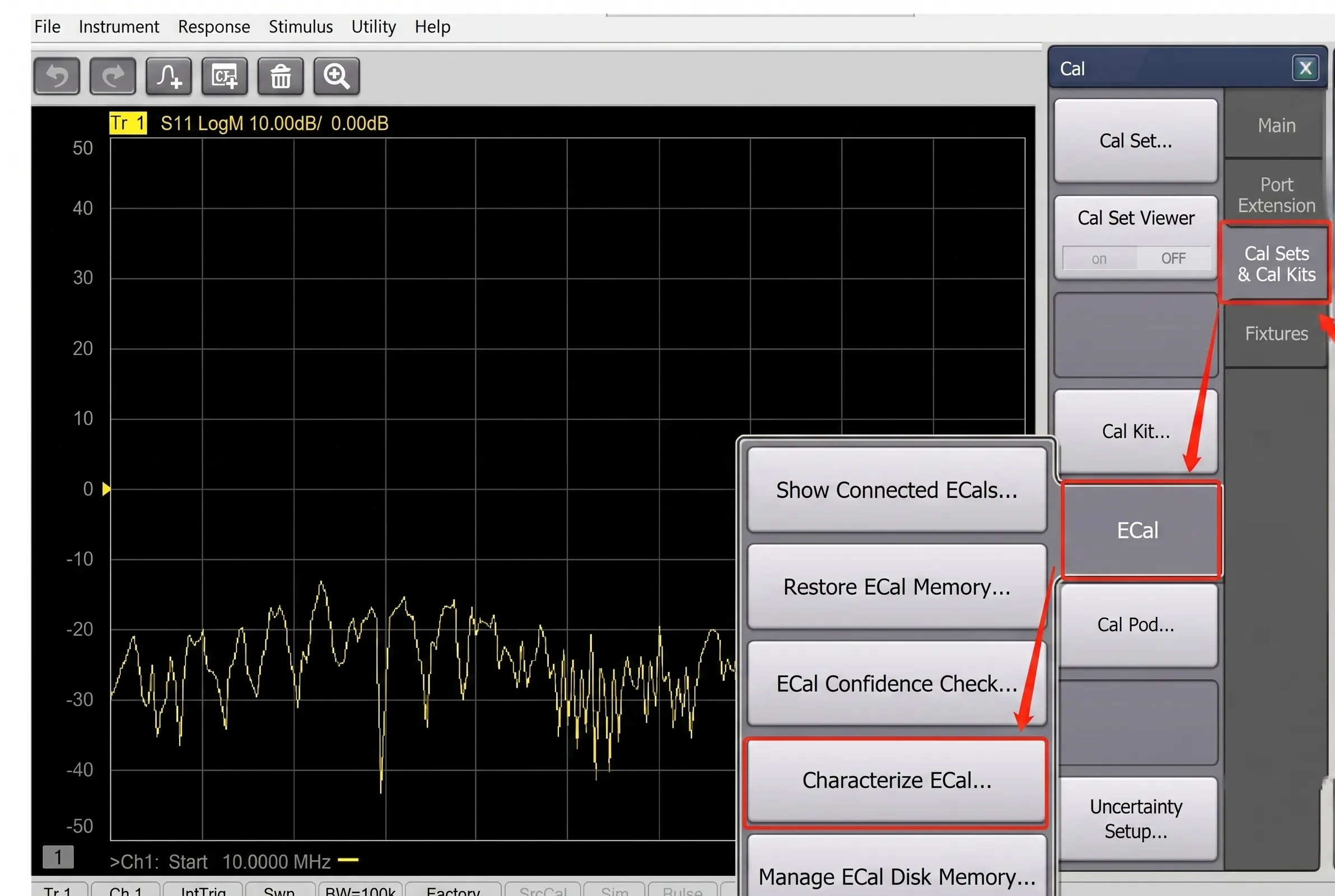
Getting an accurate measurement is a two-step process. First, you have to isolate the device you are testing. Second, you have to test it under realistic conditions.
Isolating the Device Under Test (DUT) is done through de-embedding. Your test setup, including cables, probes, and fixtures, has its own RF characteristics. It has insertion loss that will reduce the power that reaches your DUT and comes out of it. To get a true measurement of the amplifier itself, you must mathematically remove the effects of your test setup. You do this by measuring the S-parameters of your test paths without the DUT. You save these as S2P files. Then, your test software can use these files to correct the final measurement. It's like zeroing a scale before you weigh something.
Next, you must test with a realistic signal. Find the amplifier's 1dB compression point (P1dB) using a CW signal first.5 This gives you a baseline. Then, switch your signal generator to the modulated signal your system will use. Because of the signal's high PAPR, you must set its average power well below the P1dB point. A good rule of thumb is to back off by 3dB to 5dB.6 This ensures the signal peaks don't get distorted and gives you a true reading of the efficiency and linearity (ACPR) in real-world operating conditions.7
結論
Accurate efficiency measurement goes beyond datasheets. It requires the right gear, proper de-embedding, and testing with realistic modulated signals. This is the only way to truly predict your SSPA's performance.
"Peak-to-average power ratio (PAPR) of OFDM systems", https://www.etti.unibw.de/labalive/experiment/paprofdm/. Scholarly sources define the peak-to-average power ratio (PAPR) and explain that multicarrier modulation schemes such as OFDM inherently exhibit high PAPR due to the constructive interference of many subcarriers. Evidence role: definition; source type: encyclopedia. Supports: That modern modulation schemes like Orthogonal Frequency-Division Multiplexing (OFDM) and Quadrature Amplitude Modulation (QAM) are characterized by a high peak-to-average power ratio (PAPR).. ↩
"[PDF] Chapter 2 Non-linear models for High Power Amplifiers - UPCommons", https://upcommons.upc.edu/bitstreams/e5747336-ce22-49ab-b38a-4384c0d7952e/download. Research on RF power amplifiers explains that when signal peaks exceed the amplifier's linear operating range and enter saturation, clipping occurs, which generates intermodulation distortion products and degrades metrics such as ACPR and EVM. Evidence role: mechanism; source type: paper. Supports: That driving a power amplifier into its saturation region with a high-PAPR signal causes the signal peaks to be clipped, a form of nonlinear distortion that degrades signal quality, which is quantified by metrics like Adjacent Channel Power Ratio (ACPR) and Error Vector Magnitude (EVM).. ↩
"Power-added efficiency - Wikipedia", https://en.wikipedia.org/wiki/Power-added_efficiency. Standard RF and microwave engineering textbooks define Power Added Efficiency (PAE) with the formula PAE = (P_out_rf - P_in_rf) / P_dc, where P_out_rf is the RF output power, P_in_rf is the RF input power, and P_dc is the consumed DC power. Evidence role: definition; source type: education. Supports: The standard mathematical formula for calculating Power Added Efficiency (PAE).. ↩
"On the power measurement via a spectrum analyzer - IEEE Xplore", https://ieeexplore.ieee.org/document/1351221/. Test and measurement guides from instrument manufacturers explain that while spectrum analyzers are excellent for relative power measurements, their inherent amplitude uncertainty makes them less accurate for absolute power measurements compared to dedicated power meters and sensors. Evidence role: general_support; source type: other. Supports: That for accurate absolute RF power measurements, a dedicated power meter is superior to a spectrum analyzer, which is designed primarily for relative power measurements and frequency domain analysis.. Scope note: The source would likely be from a test equipment vendor, but it would be supporting a general metrology principle rather than promoting a product. ↩
"Compression point - Wikipedia", https://en.wikipedia.org/wiki/Compression_point. Reference materials in RF engineering define the 1dB compression point (P1dB) as a key metric indicating the onset of nonlinear behavior in an amplifier, marking the point where gain is reduced by 1 dB. Evidence role: definition; source type: encyclopedia. Supports: That the 1dB compression point (P1dB) is a standard figure of merit for RF amplifiers, representing the output power level at which the gain has decreased by 1 dB from its small-signal value, and is typically measured using a continuous wave (CW) signal.. ↩
"Simulate and Verify Power Amplifier Backoff - MATLAB & Simulink", https://www.mathworks.com/help/comm/ug/simulate-and-verify-power-amplifier-backoff.html. Research and application notes on power amplifier linearization discuss the necessity of power back-off, with the amount of back-off required—often in the range of 3 to 5 dB or more from P1dB—depending on the signal's PAPR and the target linearity specifications. Evidence role: general_support; source type: research. Supports: That to maintain linearity when amplifying signals with high PAPR, it is necessary to operate the amplifier at an average power level significantly backed off from its 1dB compression point, with recommended back-off values often falling in the 3-5 dB range or more.. Scope note: The exact back-off value is highly dependent on the specific signal and linearity requirements, so a source will support the principle and range rather than a single universal value. ↩
"Improving linearity and efficiency of RF power amplifiers", https://digitalcollections.sdsu.edu/do/4b40f997-ed4e-4b8c-9f46-dc9beab59d07. Studies on RF power amplifier characterization demonstrate that operating with a sufficient power back-off is crucial for preventing signal peak compression, which in turn allows for valid measurements of linearity (e.g., ACPR) and average efficiency for a given modulated signal. Evidence role: mechanism; source type: paper. Supports: That applying a power back-off ensures that the peaks of a high-PAPR signal remain within the amplifier's linear operating region, thereby preventing distortion and allowing for accurate characterization of performance metrics like efficiency and ACPR under realistic operating conditions.. ↩

 Japanese
  English
  Spanish
  French
  Arabic
  Vietnamese
  Indonesian
  Hindi
Hindi  Danish
  Bulgarian