
Are you seeing poor EVM in your satellite upconverter system? The cause might be an overlooked detail in your modulator's architecture, which is hurting your signal quality and system performance.
The main difference is function. A frequency converter simply shifts a signal's carrier frequency. An RF modulator, like a quadrature modulator, also impresses a baseband signal onto that carrier. This means it actively processes I/Q data, creating unique challenges like LO leakage and I/Q imbalance.1
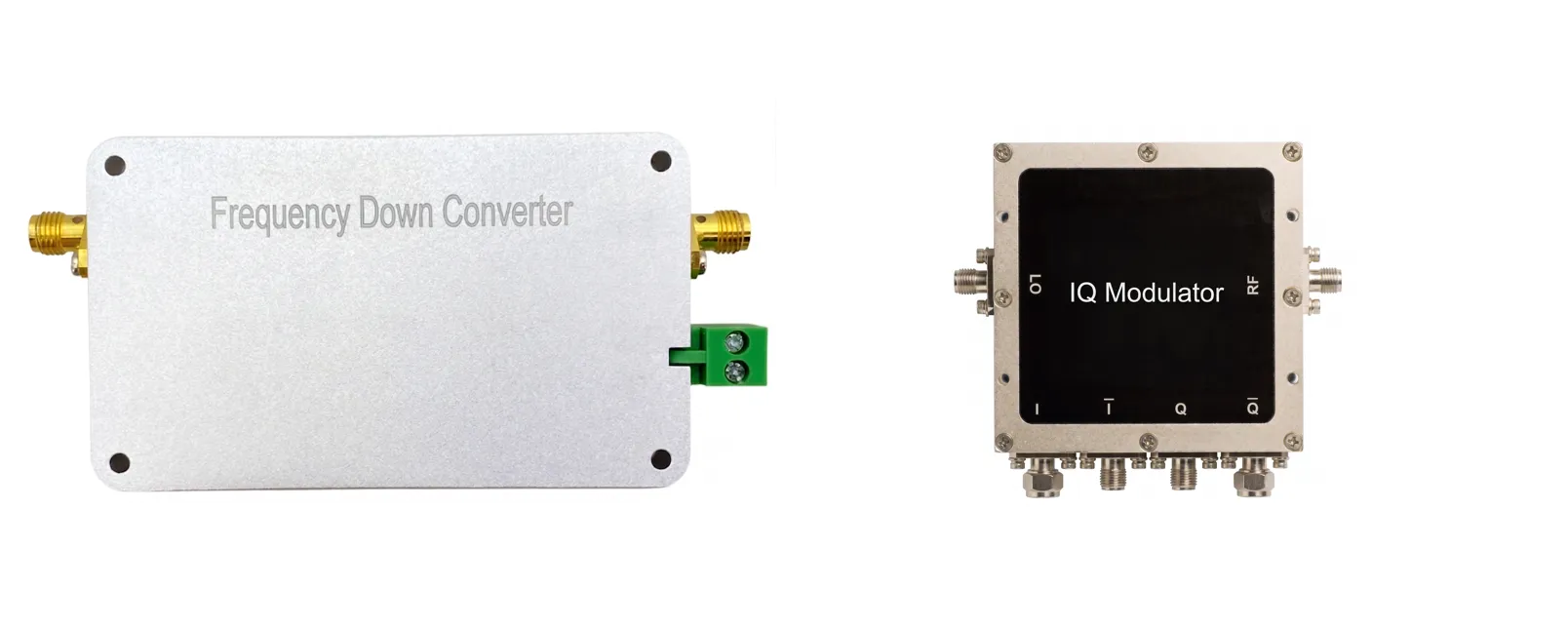
I've spent a lot of time in the lab trying to pinpoint strange performance issues. Often, the problem isn't with a single faulty component. It's about how different components interact. The distinction between a modulator and a simple frequency converter is a perfect example of this. They might seem similar, but their roles in a system are fundamentally different. Understanding this difference is the first step to building a truly high-performance RF system. Let's look at the key architectural points that set them apart and how those details impact your final design.
Why Does DC Offset in Quadrature Modulators Ruin Your System's EVM?
Is your system's Error Vector Magnitude (EVM) much worse than you calculated? This degrades your signal-to-noise ratio, making your entire system unreliable. The problem is very likely LO leakage.
In quadrature modulators, a small amount of the local oscillator (LO) signal can leak to the output. This leakage power shows up right at your carrier frequency, directly degrading your EVM.2 You can fix this by applying a specific DC offset to the I and Q inputs to cancel it out.3
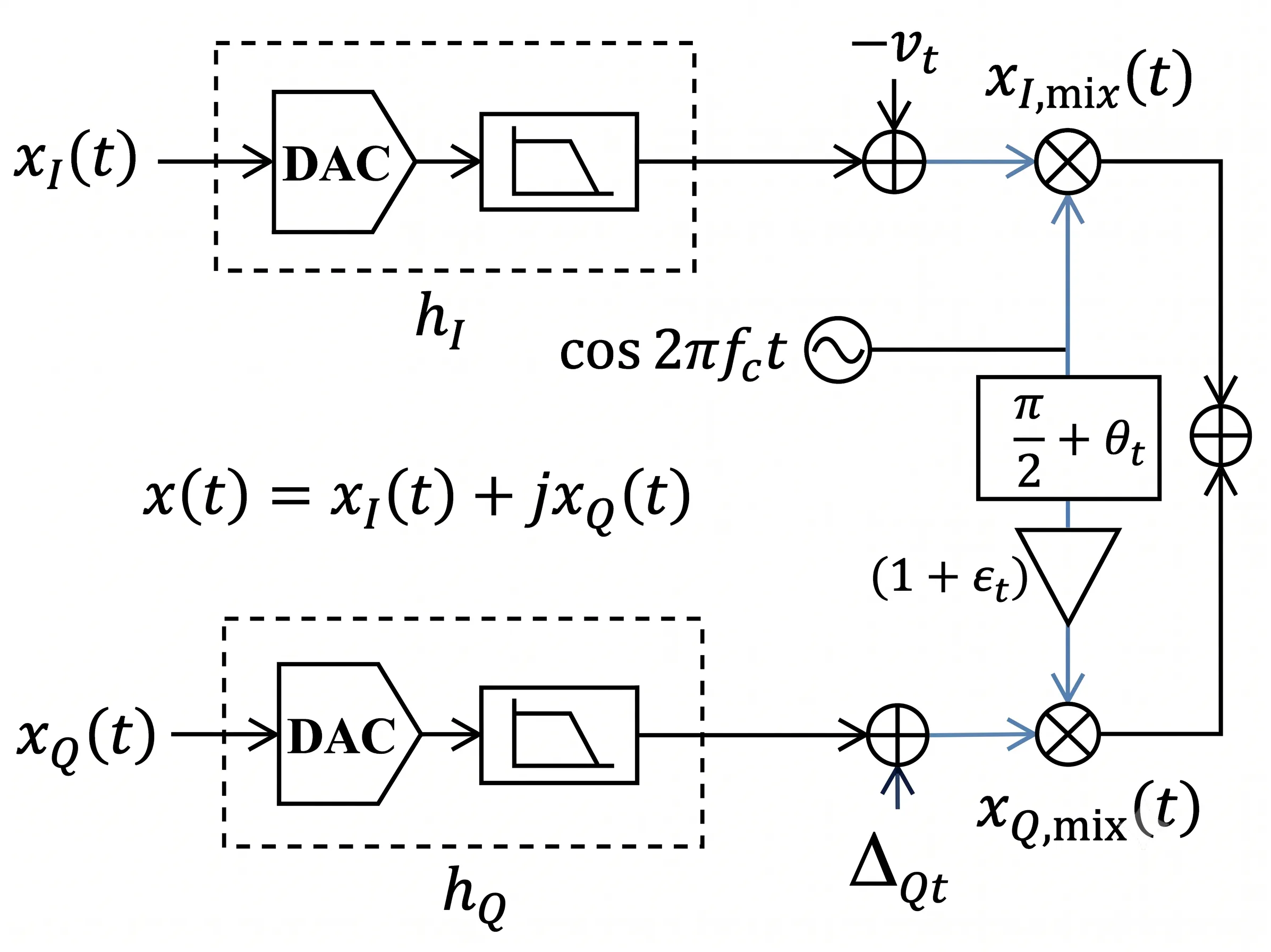
A quadrature modulator works by splitting a signal into In-phase (I) and Quadrature (Q) components. These are mixed with an LO signal and then combined. In an ideal world, if you have no baseband input, you should have no RF output. But in reality, the mixers are not perfect. A tiny bit of the LO signal "leaks" through to the output. This is called LO leakage or LO feedthrough. This leakage acts as a constant, unwanted signal right in the middle of your channel. It directly impacts your EVM, which measures how far your actual signal is from its ideal state. The leaked LO power essentially shifts the "zero point" of your signal constellation, adding a constant error to every single symbol you transmit. The solution is surprisingly simple, yet critical. By applying a very precise DC voltage to the I and Q input ports, you can generate a signal at the output that is equal in power but exactly opposite in phase to the LO leakage. They cancel each other out. This process is essential for achieving the low EVM required in high-performance communication systems.
| LO Leakage Power | Typical Impact on EVM | Correction Method |
|---|---|---|
| -40 dBc | ~1% EVM degradation | Required |
| -30 dBc | ~3% EVM degradation4 | cURL Too many subrequests by single Worker invocation. To configure this limit, refer to https://developers.cloudflare.com/workers/wrangler/configuration/#limits |
| -20 dBc | ~10% EVM degradation | System Failure |
How Do You Correct I/Q Imbalance for Better Performance?
Are you seeing unwanted image signals in your output spectrum? This poor sideband suppression can interfere with adjacent channels and ruin your spectral purity. The best way to fix this is with digital pre-distortion.
I/Q imbalance happens when the gain and phase between the I and Q signal paths are not perfectly matched.5 This allows the unwanted sideband to appear in your output. Modern systems correct this using DSP-based orthogonal compensation to pre-adjust the digital baseband signals.6
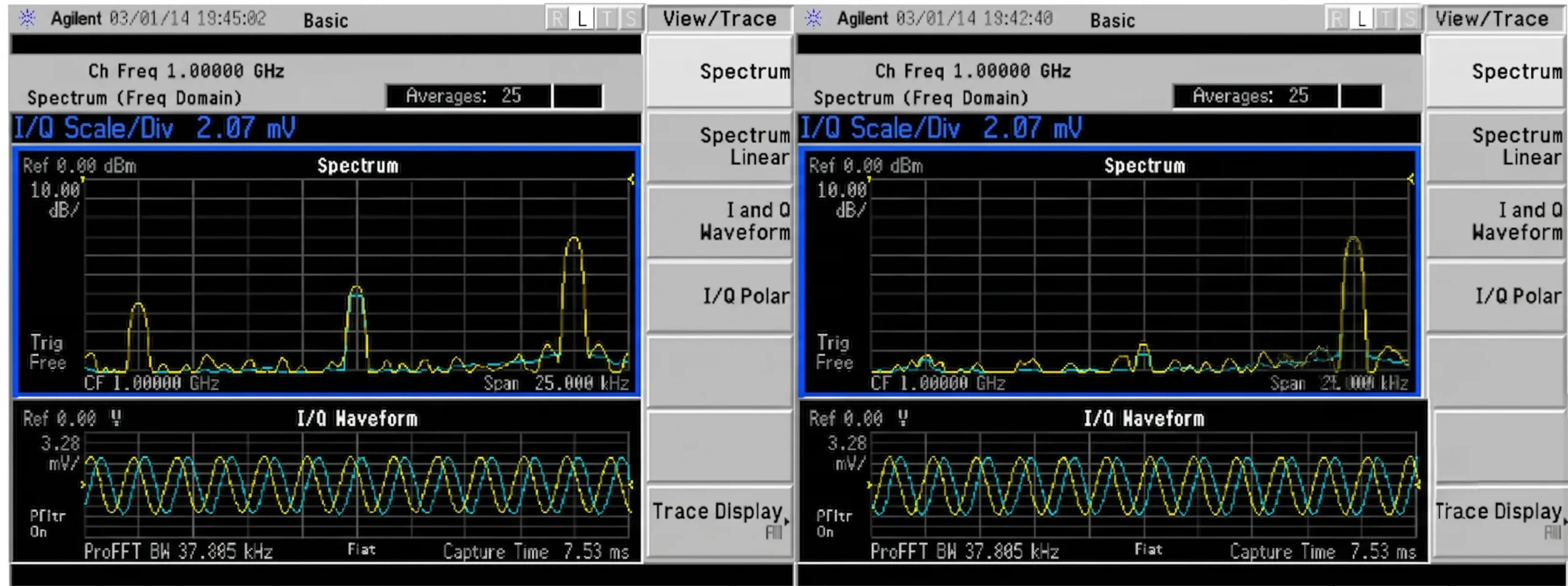
For ideal sideband suppression, the I and Q paths inside your modulator must be perfectly balanced. This means two things: their gains must be identical, and the phase shift between them must be exactly 90 degrees. Any small deviation is called I/Q imbalance. This imbalance means the unwanted sideband is not fully canceled, and it "leaks" into your output spectrum. In the past, engineers like me would physically tune tiny potentiometers on the circuit board to balance the paths. This was a difficult and unstable process, as the balance would drift with temperature and time. Today, we have a much better way. We use Digital Signal Processing (DSP) before the signal even becomes analog. By applying a gain and phase correction matrix in the digital domain, we can pre-distort the baseband I/Q signals. This pre-distortion is calculated to perfectly counteract the analog imbalances in the modulator. I've seen this method take a design with poor sideband suppression and push it to over 50 dB of rejection, all while keeping the EVM stable under 2.5%.
| Correction Method | Sideband Suppression | Stability | Implementation |
|---|---|---|---|
| Analog Trimming | 30-35 dB (Typical) | Poor (drifts with temp) | Manual, time-consuming |
| Digital (DSP) | > 50 dB7 | Excellent (very stable) | Automated, repeatable |
結論
Converters just shift frequency, but modulators process signals. Mastering DC offset for LO leakage and using DSP to correct I/Q imbalance are essential for achieving elite performance in modern systems.
"IQ imbalance - Wikipedia", https://en.wikipedia.org/wiki/IQ_imbalance. Explains the architecture of quadrature modulators and details how practical imperfections in the mixers and 90-degree phase shifters are the root causes of LO leakage and I/Q imbalance, respectively. Evidence role: mechanism; source type: paper. Supports: The source should explain the internal workings of a quadrature modulator, showing how non-ideal components like mixers and phase splitters lead to impairments such as Local Oscillator (LO) leakage and I/Q imbalance.. ↩
"Error vector magnitude - Wikipedia", https://en.wikipedia.org/wiki/Error_vector_magnitude. Demonstrates that LO leakage introduces an unwanted signal component at the carrier frequency, which corresponds to a DC offset in the baseband I/Q plane. This offset shifts the entire signal constellation, leading to a systematic increase in error vector magnitude (EVM). Evidence role: mechanism; source type: paper. Supports: The source should demonstrate how LO leakage, which manifests as a DC offset in the baseband, shifts the origin of the signal constellation diagram, thereby increasing the error vector for every symbol and degrading the overall EVM.. ↩
"cURL Too many subrequests by single Worker invocation. To configure this limit, refer to https://developers.cloudflare.com/workers/wrangler/configuration/#limits. ↩
"cURL Too many subrequests by single Worker invocation. To configure this limit, refer to https://developers.cloudflare.com/workers/wrangler/configuration/#limits. ↩
"cURL Too many subrequests by single Worker invocation. To configure this limit, refer to https://developers.cloudflare.com/workers/wrangler/configuration/#limits. ↩
"cURL Too many subrequests by single Worker invocation. To configure this limit, refer to https://developers.cloudflare.com/workers/wrangler/configuration/#limits. ↩
"cURL Too many subrequests by single Worker invocation. To configure this limit, refer to https://developers.cloudflare.com/workers/wrangler/configuration/#limits. ↩

 Japanese
  English
  Spanish
  French
  Arabic
  Vietnamese
  Indonesian
  Hindi
Hindi  Danish
  Bulgarian