
Your BUC keeps overheating, causing link failures and costly replacements. This constant worry over system reliability is frustrating. Let's explore why thermal management is the key to solving this.
Your BUC is likely overheating due to inefficient power conversion. The internal power amplifier (PA) generates significant waste heat.1 Without proper heatsinking and airflow, this heat gets trapped, raising the internal temperature and leading to performance degradation and premature failure.

I've been designing satellite systems for over 15 years. I have seen brilliant engineers select BUCs with perfect linearity and LO stability, only to watch them fail prematurely. They missed the silent killer: heat. Understanding where this heat comes from is the first step, but the real solution lies in how you manage it. Let's dig into the core of the problem and find a practical solution.
What Makes a BUC Get So Hot in the First Place?
You see the high temperatures on your BUC, but the exact cause is a mystery. This uncertainty makes finding a real solution impossible. Let's break down the heat sources.
The primary heat source in a BUC is the solid-state power amplifier (SSPA), especially its GaN or GaAs transistors2. They are not 100% efficient. A lot of DC power is converted into heat, not RF power. This inefficiency is the root cause.
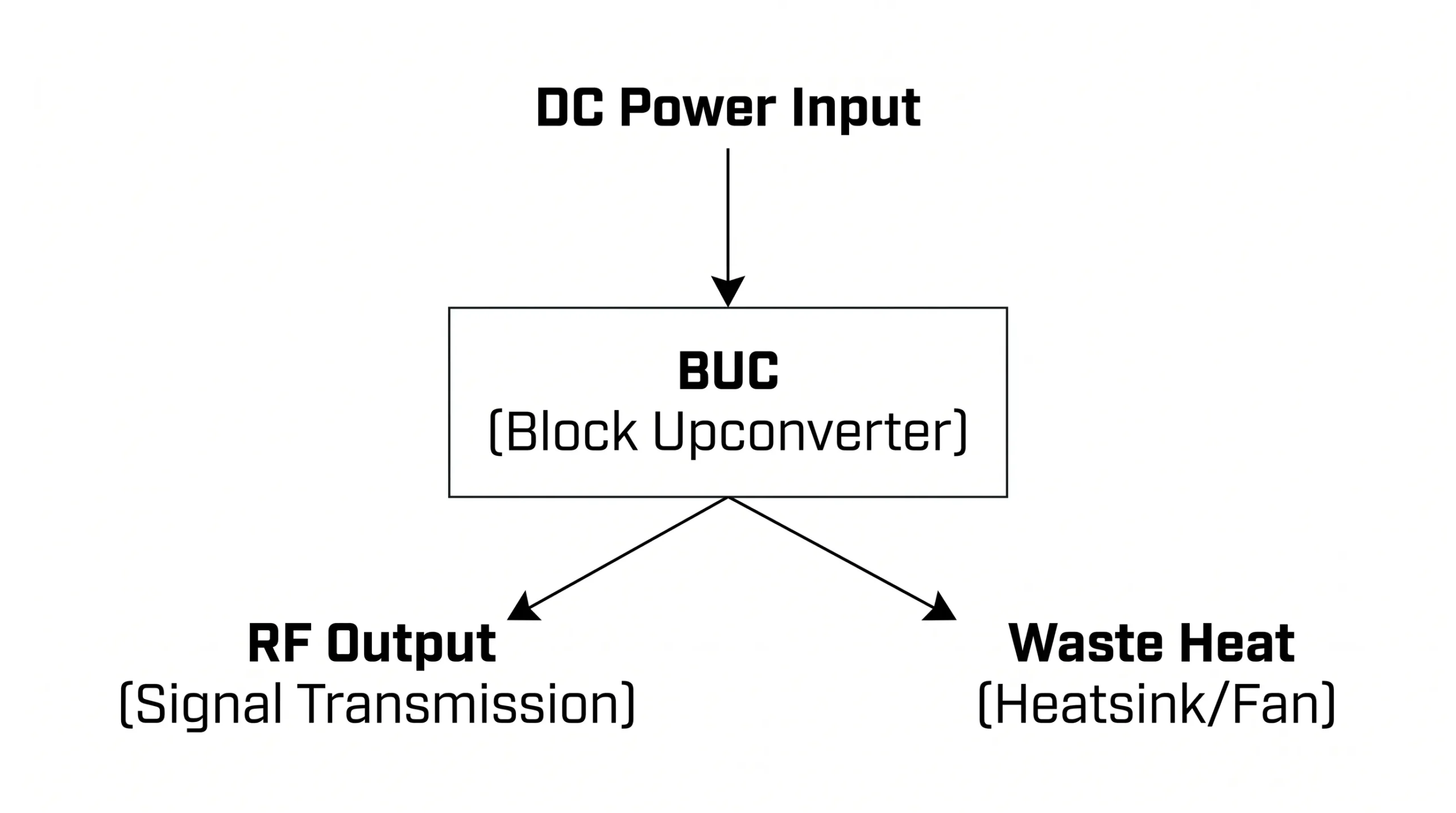
The heart of any BUC is its power amplifier. We rely on it to boost our signal for uplink, but it's also the main heat generator. Think of it in terms of efficiency. Power Added Efficiency (PAE)3 tells us how much DC input power becomes useful RF output power. A BUC with 30% PAE means 70% of the power you supply is lost as heat. For a 100W BUC, that's a lot of thermal energy to manage.
Key Heat Sources in a BUC
- Power Amplifier (PA): This is the biggest offender. The semiconductor transistors (GaN/GaAs) are the focal point of heat generation during signal amplification.
- Power Supply Unit (PSU): The internal DC-DC converters also have their own inefficiencies, contributing to the overall thermal load.
- Control Circuitry: While minor, these components also add a small amount of heat.
Let's look at a simple example for a typical BUC:
| Input DC Power | PAE | RF Output Power | Waste Heat |
|---|---|---|---|
| 300 W | 33% | 100 W | 200 W |
As you can see, the waste heat is double the useful RF power. This is the heat we must remove effectively. If you don't have a plan for this heat, it has nowhere to go. It just builds up inside the unit.
How Can Poor Thermal Design Cut a BUC's Lifespan?
You might ignore the BUC's high operating temperature, thinking it's normal. But this heat is silently destroying your investment, leading to sudden and catastrophic system failures.
High temperatures accelerate component aging, especially for semiconductors and capacitors. For every 10°C increase in junction temperature, the lifespan of a semiconductor can be cut in half. This leads to reduced reliability, performance degradation, and eventual BUC failure.
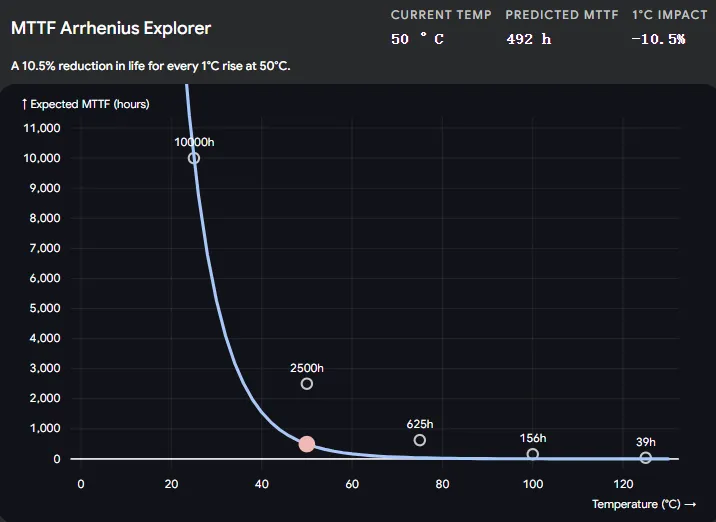
In my early days, a client complained their BUC performance was dropping after a few months in the field. The culprit? Poor ventilation. The heat was slowly cooking the internal components. This is explained by a principle known as the Arrhenius equation4. A simplified version, the "10-degree rule," states that the failure rate of electronic components doubles for every 10°C rise in temperature. This is not just a theory; I have seen it happen in the real world.
cURL Too many subrequests by single Worker invocation. To configure this limit, refer to https://developers.cloudflare.com/workers/wrangler/configuration/#limits
- cURL Too many subrequests by single Worker invocation. To configure this limit, refer to https://developers.cloudflare.com/workers/wrangler/configuration/#limits cURL Too many subrequests by single Worker invocation. To configure this limit, refer to https://developers.cloudflare.com/workers/wrangler/configuration/#limits.
- cURL Too many subrequests by single Worker invocation. To configure this limit, refer to https://developers.cloudflare.com/workers/wrangler/configuration/#limits cURL Too many subrequests by single Worker invocation. To configure this limit, refer to https://developers.cloudflare.com/workers/wrangler/configuration/#limits.
- cURL Too many subrequests by single Worker invocation. To configure this limit, refer to https://developers.cloudflare.com/workers/wrangler/configuration/#limits cURL Too many subrequests by single Worker invocation. To configure this limit, refer to https://developers.cloudflare.com/workers/wrangler/configuration/#limits cURL Too many subrequests by single Worker invocation. To configure this limit, refer to https://developers.cloudflare.com/workers/wrangler/configuration/#limits5. cURL Too many subrequests by single Worker invocation. To configure this limit, refer to https://developers.cloudflare.com/workers/wrangler/configuration/#limits.
cURL Too many subrequests by single Worker invocation. To configure this limit, refer to https://developers.cloudflare.com/workers/wrangler/configuration/#limits.
What Are the Most Effective Heatsinking Strategies for BUCs?
cURL Too many subrequests by single Worker invocation. To configure this limit, refer to https://developers.cloudflare.com/workers/wrangler/configuration/#limits.
cURL Too many subrequests by single Worker invocation. To configure this limit, refer to https://developers.cloudflare.com/workers/wrangler/configuration/#limits.

cURL Too many subrequests by single Worker invocation. To configure this limit, refer to https://developers.cloudflare.com/workers/wrangler/configuration/#limits.
cURL Too many subrequests by single Worker invocation. To configure this limit, refer to https://developers.cloudflare.com/workers/wrangler/configuration/#limits
- cURL Too many subrequests by single Worker invocation. To configure this limit, refer to https://developers.cloudflare.com/workers/wrangler/configuration/#limits cURL Too many subrequests by single Worker invocation. To configure this limit, refer to https://developers.cloudflare.com/workers/wrangler/configuration/#limits.
- cURL Too many subrequests by single Worker invocation. To configure this limit, refer to https://developers.cloudflare.com/workers/wrangler/configuration/#limits cURL Too many subrequests by single Worker invocation. To configure this limit, refer to https://developers.cloudflare.com/workers/wrangler/configuration/#limits. cURL Too many subrequests by single Worker invocation. To configure this limit, refer to https://developers.cloudflare.com/workers/wrangler/configuration/#limits.6 cURL Too many subrequests by single Worker invocation. To configure this limit, refer to https://developers.cloudflare.com/workers/wrangler/configuration/#limits.
- cURL Too many subrequests by single Worker invocation. To configure this limit, refer to https://developers.cloudflare.com/workers/wrangler/configuration/#limits cURL Too many subrequests by single Worker invocation. To configure this limit, refer to https://developers.cloudflare.com/workers/wrangler/configuration/#limits.
Think of it like a chain. The heat needs to flow smoothly. Any weak link, like a missing TIM or a loose screw, will break the chain and cause heat to back up inside the BUC.
Can Advanced Cooling Techniques Like Fans or Liquid Cooling Help?
Your high-power BUC is still overheating, even with a large heatsink. The thermal limits are being pushed, threatening your system's stability. Let's explore more powerful cooling methods.
Yes, active cooling is highly effective. Fans (forced convection) dramatically increase a heatsink's efficiency by moving hot air away. For extremely high-power or compact systems, liquid cooling offers the highest performance7 by using a fluid to transport heat to a remote radiator.

When passive cooling hits its limit, we must get proactive. This means moving from natural convection to forced convection. The simplest way is to add a fan. A fan blowing air across a heatsink's fins can improve its cooling performance by two to three times, or even more. This is often essential for BUCs operating in hot climates or enclosed spaces with poor airflow.
For the most demanding applications, like our 3000-watt SSPA, even fans aren't enough. Here, we turn to liquid cooling. This involves a cold plate attached to the BUC, with a liquid pumped through it to carry heat away to a radiator. It's more complex and expensive, but its heat removal capacity is unmatched for extreme power densities.
Comparing Cooling Methods
| Cooling Method | Mga Bentaha | Mga Disbentaha | Pinakamaayo Para sa |
|---|---|---|---|
| Passive Heatsink | Simple, reliable, no power | Limited performance, bulky | Low to medium power BUCs |
| Forced Air (Fans) | High performance, cost-effective | Noise, dust, fan failure risk | Medium to high power BUCs |
| Liquid Cooling | Highest performance, compact | Complex, expensive, leak risk | Very high power, dense systems |
How Do You Integrate Thermal Management into Your System Design from Day One?
You've built your system, but now it's overheating. Retrofitting a cooling solution is difficult and expensive, often leading to compromises. Let's plan for heat from the start.
Integrate thermal management by calculating the total thermal load (waste heat) from all components early on. Model the airflow within your enclosure and select a BUC and heatsink combination that provides a sufficient thermal margin for your worst-case operating environment.
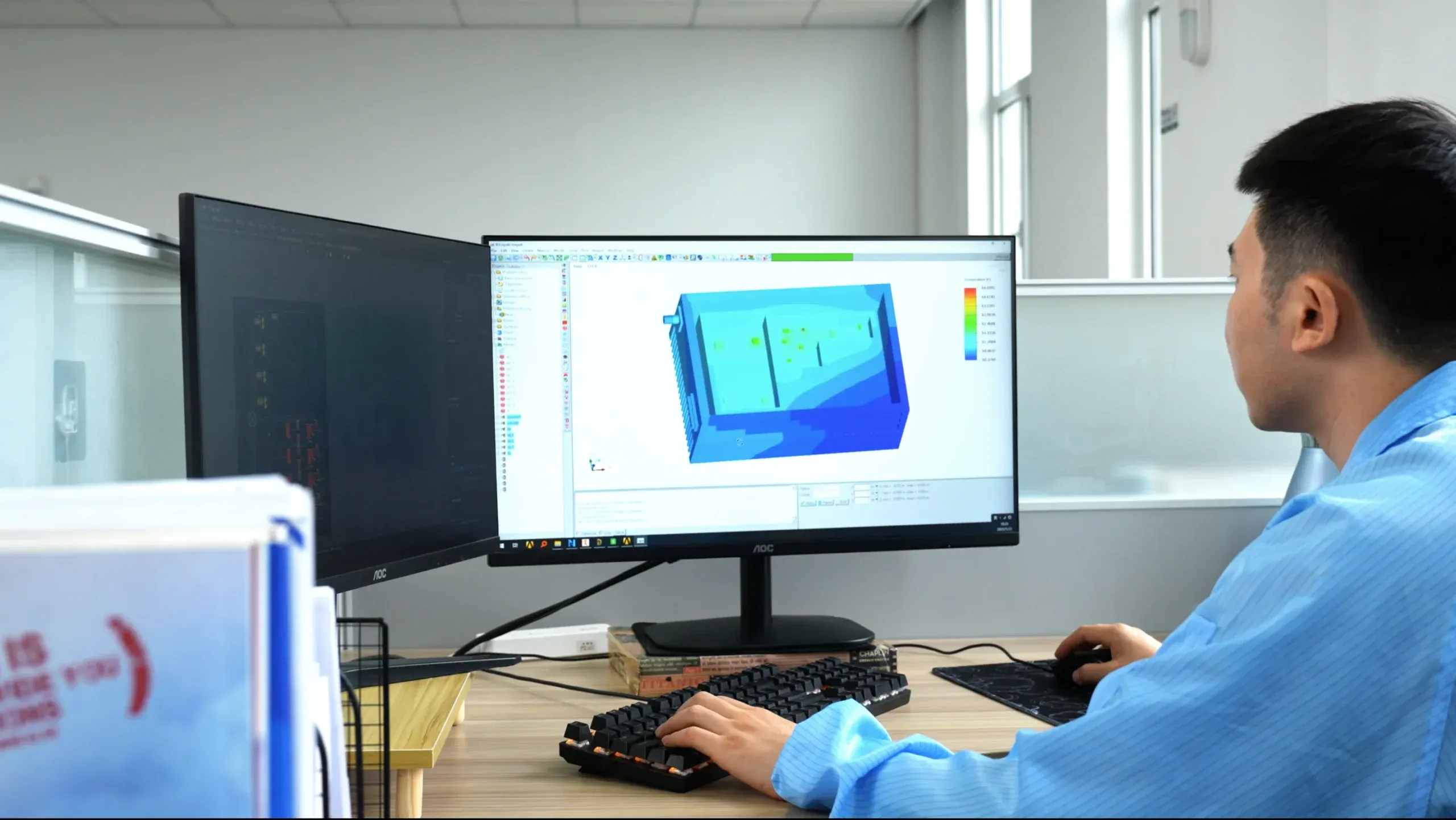
I've seen too many projects where thermal management was the last thing on the checklist. This is a recipe for disaster. You must think about heat from the moment you start your block diagram. The first step is to create a thermal budget. Just like a power budget, you need to calculate how much waste heat your system will produce. The BUC will almost always be your biggest contributor.
Key Steps for Proactive Thermal Design
- Know Your Environment: Where will this system operate? A desert has a much higher ambient temperature and solar load than an indoor lab. You must design for the worst-case scenario.
- Positioning is Everything: Don't trap your BUC in a corner with no airflow. Ensure it's mounted in a location with clear airflow. If using fans, make sure the BUC is in the path of the moving air.
- Read the Datasheet: Pay close attention to the BUC's thermal specifications. The manufacturer provides the thermal resistance from the internal transistor junction to the case.8 This number is crucial for calculating the final operating temperature.
- Prototype and Test: Build a thermal mockup early in the design process. Use thermocouples to measure real-world temperatures under full load. Don't wait for the final system integration to discover a problem.
Konklusyon
Overheating shortens your BUC's life. Understanding its causes and designing for thermal management from the start ensures system reliability and longevity, protecting your investment for years to come.
"Design considerations for radio frequency power converters", https://purl.stanford.edu/xd153mn2607. Provides a technical explanation of how solid-state power amplifiers (SSPAs) convert DC electrical power into radio frequency (RF) power, noting that inefficiencies in this process result in the generation of significant waste heat. Evidence role: mechanism; source type: education. Supports: That power amplifiers generate significant waste heat as an inherent byproduct of the power conversion process.. ↩
"Thermal Study of a GaN-Based HEMT - Curate ND", https://curate.nd.edu/articles/thesis/Thermal_Study_of_a_GaN-Based_HEMT/24858864. Discusses the thermal properties and high power density of Gallium Nitride (GaN) and Gallium Arsenide (GaAs) transistors used in high-frequency power amplifiers, identifying the active transistor junction as the focal point of heat generation. Evidence role: mechanism; source type: paper. Supports: That GaN and GaAs transistors are the primary heat-generating components in modern solid-state power amplifiers.. ↩
"Power-added efficiency - Wikipedia", https://en.wikipedia.org/wiki/Power-added_efficiency. Defines Power Added Efficiency (PAE) as a key performance metric for RF power amplifiers, calculated as the ratio of the added RF power (output minus input) to the total DC power consumed, which quantifies the efficiency of DC to RF power conversion. Evidence role: definition; source type: education. Supports: The formal definition and formula for Power Added Efficiency (PAE) in the context of RF amplifiers.. ↩
"[PDF] Reaction Rates and Temperature; Arrhenius Theory", https://www.chem.tamu.edu/rgroup/hughbanks/courses/102/slides/slides17_2.pdf. Provides the formulation of the Arrhenius equation and describes its use in reliability engineering to model the relationship between temperature and the rate of chemical and physical degradation processes in electronic components. Evidence role: definition; source type: encyclopedia. Supports: The definition of the Arrhenius equation and its application in predicting the temperature-dependent failure rates of electronic components.. ↩
"[PDF] THERMAL AND THERMOMECHANICAL ANALYSIS AND TESTING ...", https://secwww.jhuapl.edu/techdigest/content/techdigest/pdf/V07-N03/07-03-Clatterbaugh.pdf. Explains how repeated temperature fluctuations (thermal cycling) induce thermomechanical stress in solder joints due to mismatches in the coefficient of thermal expansion (CTE) between components and the circuit board, leading to crack initiation and propagation, and eventual failure. Evidence role: mechanism; source type: paper. Supports: The mechanism of solder joint fatigue and failure due to thermal cycling.. ↩
"Thermal interface material - Wikipedia", https://en.wikipedia.org/wiki/Thermal_interface_material. Provides a comparison of the thermal conductivity of various materials, showing that air (≈0.026 W/m·K) is a thermal insulator compared to metals like aluminum (≈205 W/m·K) or thermal interface materials, which illustrates why minimizing air gaps is critical for effective heat transfer. Evidence role: statistic; source type: education. Supports: That air has very low thermal conductivity compared to materials used for thermal management.. ↩
"cURL Too many subrequests by single Worker invocation. To configure this limit, refer to https://developers.cloudflare.com/workers/wrangler/configuration/#limits. ↩
"cURL Too many subrequests by single Worker invocation. To configure this limit, refer to https://developers.cloudflare.com/workers/wrangler/configuration/#limits. ↩

 Cebuano
  English
  Spanish (Spain)
  Arabic
  French (France)
  Vietnamese
  Indonesian
  Belarusian
  Moroccan Arabic
  Tibetan
  Danish
  Bulgarian
  Bosnian
  Catalan
  Frisian
  Japanese
  Bashkir
  French (Belgium)
  Estonian
  Hindi
Hindi  Kurdish
  Tahitian
  Spanish (Colombia)
  Croatian
  Breton
  Georgian