
Your RF system's gawas nga gahum1 is unstable. This drift ruins test results and communication links. Automatic Level Control (ALC)2 provides the constant, reliable output power you need.
The primary reason to use Automatic Level Control (ALC) with an RF power amplifier is to maintain a constant and stable output power. It automatically compensates for variations in input signal level3, temperature changes, and amplifier gain drift4, ensuring consistent performance and protecting downstream components.
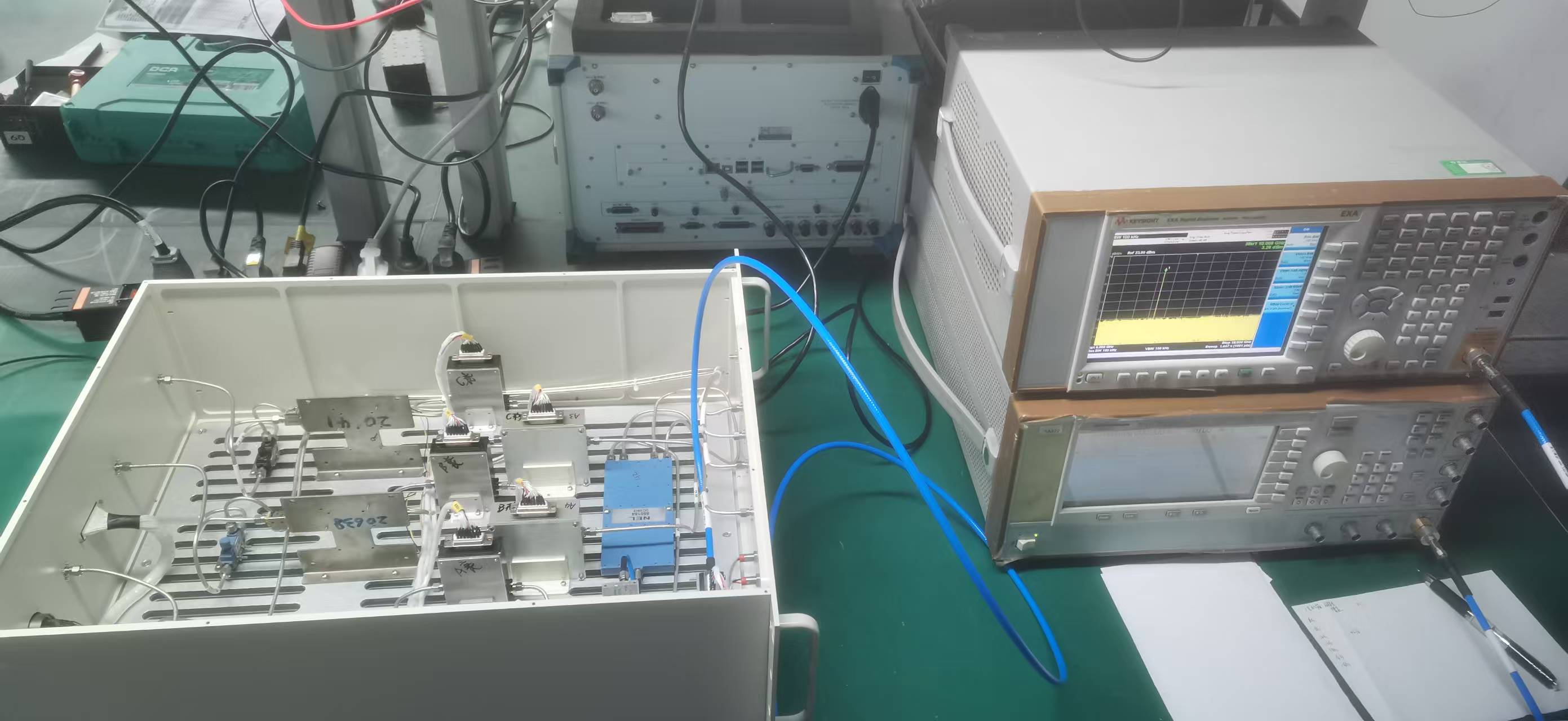
I first saw an ALC function on a signal generator. My mentor told me to always turn it on for stable output, but I didn't fully understand why. It wasn't until I worked with Remote Radio Unit (RRU) systems that the purpose of ALC in a power amplifier clicked. But that raised a new question for me. If a system already has digital and voltage-controlled attenuators, why do we still need an amplifier with ALC? Let me walk you through what I learned and explain the critical role ALC plays.
What is Automatic Level Control (ALC) in an RF system?
You need a steady output signal, but many factors cause it to fluctuate. This instability can make your entire system unreliable. ALC acts like a cruise control for your signal.
Automatic Level Control is a feedback loop circuit5. It samples the amplifier's output power, compares it to a fixed reference voltage, and then adjusts the amplifier's gain. This process ensures the final output power remains constant, regardless of input signal changes or environmental factors.
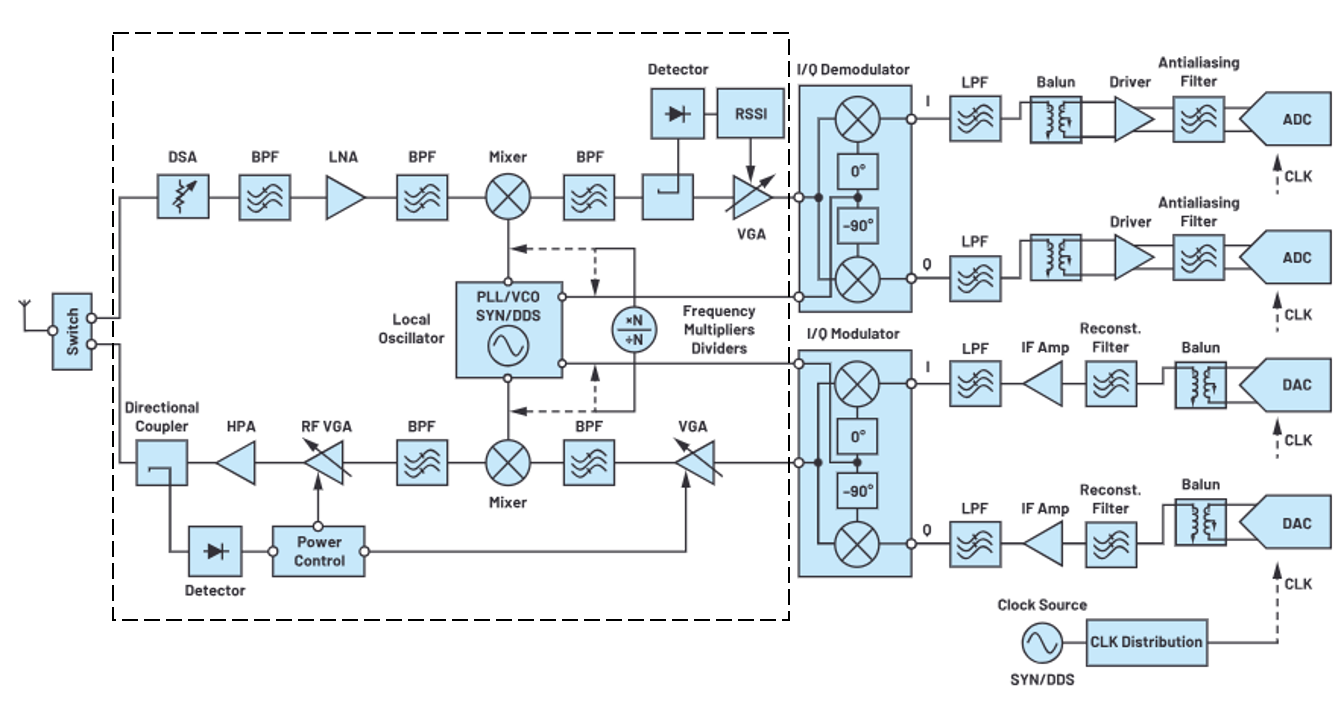
I want to break down this concept further. Think of ALC as a closed-loop control system. Its main job is to regulate power. The system continuously monitors its own output and makes real-time adjustments. This is different from an open-loop system, which has no feedback and can't correct for errors.
The Core Components
An ALC system has a few key parts. It starts with a directional coupler6 that samples a small portion of the output signal. This sample goes to a detector, which converts the RF power into a DC voltage. This voltage is then compared against a stable reference voltage.
The Adjustment Mechanism
The difference between the detected voltage and the reference voltage creates an error signal7. This signal controls a variable attenuator8 or the amplifier's gain directly. If the output power is too high, the gain is reduced. If it's too low, the gain is increased. This constant feedback loop keeps the output level right where you want it. This dynamic adjustment is what makes ALC so powerful for maintaining system performance.
How does an ALC circuit actually work in a power amplifier?
The theory of ALC sounds simple. But how do these components work together inside a power amplifier? Understanding the mechanics reveals its true power for system stability and reliability.
An ALC circuit in a power amplifier uses a directional coupler to tap a sample of the output RF power. A detector converts this sample into a DC voltage. This voltage is compared to a set reference voltage. The resulting error signal then controls a PIN diode attenuator9 or adjusts the amplifier's bias10 to maintain a constant output.
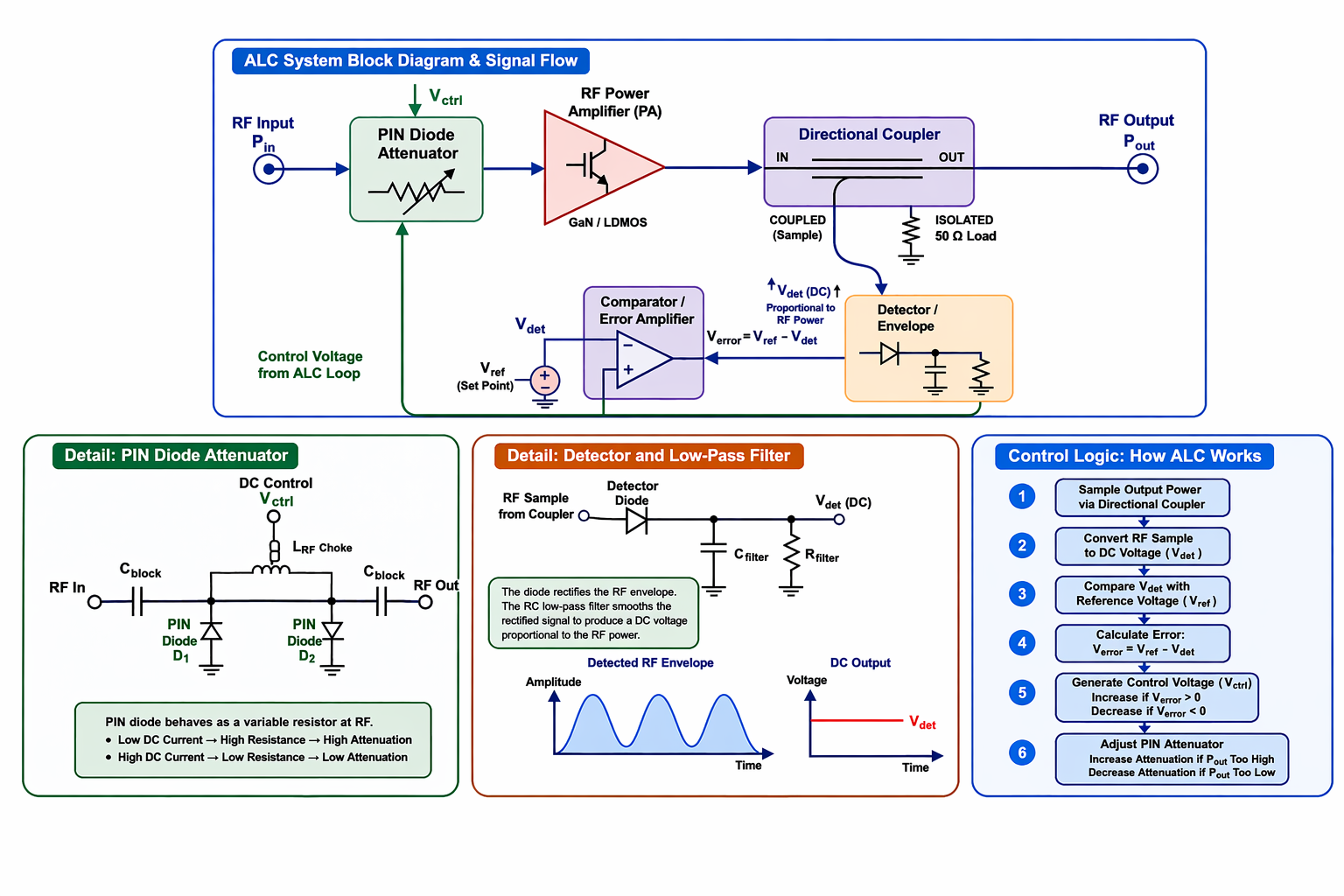
Let's get into the specifics of the hardware. The magic of the ALC loop happens through a few carefully selected components working in sync. The quality of these components directly impacts the performance of the entire ALC system, which is why we pay close attention to them at Safari Microwave.
Key Hardware Elements
| Component | Function | Safari Microwave's Role |
|---|---|---|
| Directional Coupler | Samples a known fraction of the output power without affecting the main signal path. | cURL Too many subrequests by single Worker invocation. To configure this limit, refer to https://developers.cloudflare.com/workers/wrangler/configuration/#limits. |
| cURL Too many subrequests by single Worker invocation. To configure this limit, refer to https://developers.cloudflare.com/workers/wrangler/configuration/#limits | cURL Too many subrequests by single Worker invocation. To configure this limit, refer to https://developers.cloudflare.com/workers/wrangler/configuration/#limits. | cURL Too many subrequests by single Worker invocation. To configure this limit, refer to https://developers.cloudflare.com/workers/wrangler/configuration/#limits. |
| cURL Too many subrequests by single Worker invocation. To configure this limit, refer to https://developers.cloudflare.com/workers/wrangler/configuration/#limits | cURL Too many subrequests by single Worker invocation. To configure this limit, refer to https://developers.cloudflare.com/workers/wrangler/configuration/#limits. | cURL Too many subrequests by single Worker invocation. To configure this limit, refer to https://developers.cloudflare.com/workers/wrangler/configuration/#limits. |
| cURL Too many subrequests by single Worker invocation. To configure this limit, refer to https://developers.cloudflare.com/workers/wrangler/configuration/#limits | cURL Too many subrequests by single Worker invocation. To configure this limit, refer to https://developers.cloudflare.com/workers/wrangler/configuration/#limits. | cURL Too many subrequests by single Worker invocation. To configure this limit, refer to https://developers.cloudflare.com/workers/wrangler/configuration/#limits. |
cURL Too many subrequests by single Worker invocation. To configure this limit, refer to https://developers.cloudflare.com/workers/wrangler/configuration/#limits.
cURL Too many subrequests by single Worker invocation. To configure this limit, refer to https://developers.cloudflare.com/workers/wrangler/configuration/#limits
cURL Too many subrequests by single Worker invocation. To configure this limit, refer to https://developers.cloudflare.com/workers/wrangler/configuration/#limits.
cURL Too many subrequests by single Worker invocation. To configure this limit, refer to https://developers.cloudflare.com/workers/wrangler/configuration/#limits.
| cURL Too many subrequests by single Worker invocation. To configure this limit, refer to https://developers.cloudflare.com/workers/wrangler/configuration/#limits | cURL Too many subrequests by single Worker invocation. To configure this limit, refer to https://developers.cloudflare.com/workers/wrangler/configuration/#limits | cURL Too many subrequests by single Worker invocation. To configure this limit, refer to https://developers.cloudflare.com/workers/wrangler/configuration/#limits |
|---|---|---|
| cURL Too many subrequests by single Worker invocation. To configure this limit, refer to https://developers.cloudflare.com/workers/wrangler/configuration/#limits | cURL Too many subrequests by single Worker invocation. To configure this limit, refer to https://developers.cloudflare.com/workers/wrangler/configuration/#limits | cURL Too many subrequests by single Worker invocation. To configure this limit, refer to https://developers.cloudflare.com/workers/wrangler/configuration/#limits |
| cURL Too many subrequests by single Worker invocation. To configure this limit, refer to https://developers.cloudflare.com/workers/wrangler/configuration/#limits | cURL Too many subrequests by single Worker invocation. To configure this limit, refer to https://developers.cloudflare.com/workers/wrangler/configuration/#limits | Output feedback (power detection) |
| Output Stability | Dependent on device characteristics | Automatically regulated to set level |
| Environmental Compensation | No compensation (temperature, supply variation) | Compensates temperature & supply variations |
| Dynamic Response | Static setting | Real-time adaptive control |
| System Complexity | Simple | More complex (feedback loop required) |
This is the question that really bugged me for a while. It seems redundant to have so many ways to control power. But each component serves a distinct purpose. Think of it like driving a car.
Different Tools for Different Jobs
A digital step attenuator is like your car's gear shifter. You use it to make large, discrete changes to your power level. You set it to get into the right general range for your application.
A voltage-controlled variable attenuator (VVA) is like the gas pedal. It allows for fine, continuous adjustment of the power level. You can use it to precisely set your output under specific, known conditions.
However, neither of these components knows what the amplifier's gain is doing. If the amplifier's gain drops because it gets hot, the gawas nga gahum1 will drop too. The attenuators won't know to compensate because they are not part of a feedback loop.
An ALC loop is like the cruise control. It measures the actual output (your speed) and automatically adjusts the gain (the engine) to keep it constant, no matter if you're going uphill (temperature drift) or downhill. It handles the dynamic, unpredictable changes that other components can't.
What are the key benefits of using ALC with a power amplifier?
You know ALC stabilizes power. But what specific advantages does this bring to your design? The benefits extend beyond simple stability, impacting linearity, reliability, and overall system performance.
The main benefits are: constant gawas nga gahum1 despite input and temperature variations, improved amplifier linearity by preventing saturation, protection of downstream components from overpower conditions, and simplified system-level power management. This leads to more reliable and repeatable system performance.
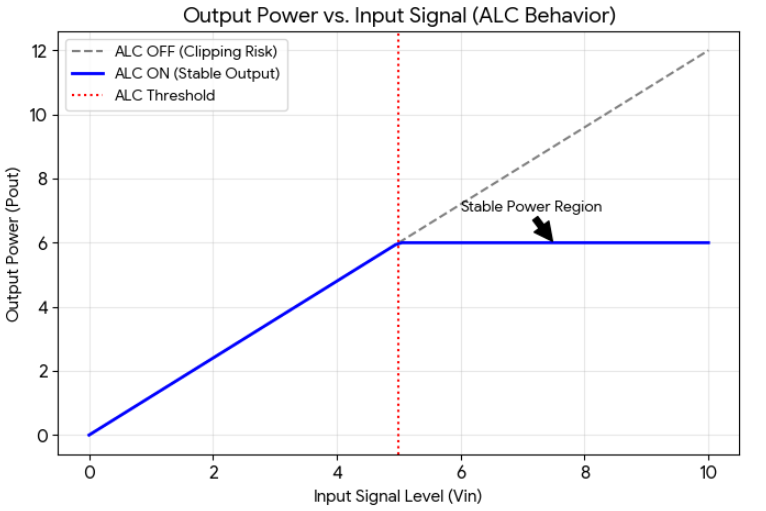
Using an amplifier with a built-in ALC simplifies your life as a system designer. It offloads a lot of the compensation work you would otherwise have to do. As someone who has to source reliable components for clients, I see these benefits firsthand.
1. Guaranteed Power Stability
The most obvious benefit is a rock-solid output level. This is critical in test and measurement systems11 where accuracy is everything. It's also vital in communication systems to maintain signal quality and link budget.
2. Enhanced Linearity and Spurious Performance
Power amplifiers perform best within a specific power range. If the input signal is too strong, it can push the amplifier into compression or saturation. This creates distortion and unwanted spurious signals. ALC acts as a governor, ensuring the amplifier always operates in its linear region. Our "Low-Spurious" high-power amplifiers, like our 3000W model, benefit greatly from this.
3. Component Protection
Sudden spikes in RF power can damage sensitive components downstream, like mixers, ADCs, or antennas. The ALC loop responds quickly to prevent these overpower conditions, acting as a built-in protection circuit. This increases the reliability of your entire system.
When should you prioritize an RF power amplifier with ALC?
Not every application needs ALC. So when is it a must-have feature? Knowing when to specify an ALC-equipped amplifier can save you from major design headaches later on.
cURL Too many subrequests by single Worker invocation. To configure this limit, refer to https://developers.cloudflare.com/workers/wrangler/configuration/#limits, mga sistema sa radar12, cURL Too many subrequests by single Worker invocation. To configure this limit, refer to https://developers.cloudflare.com/workers/wrangler/configuration/#limits cURL Too many subrequests by single Worker invocation. To configure this limit, refer to https://developers.cloudflare.com/workers/wrangler/configuration/#limits13 cURL Too many subrequests by single Worker invocation. To configure this limit, refer to https://developers.cloudflare.com/workers/wrangler/configuration/#limits.
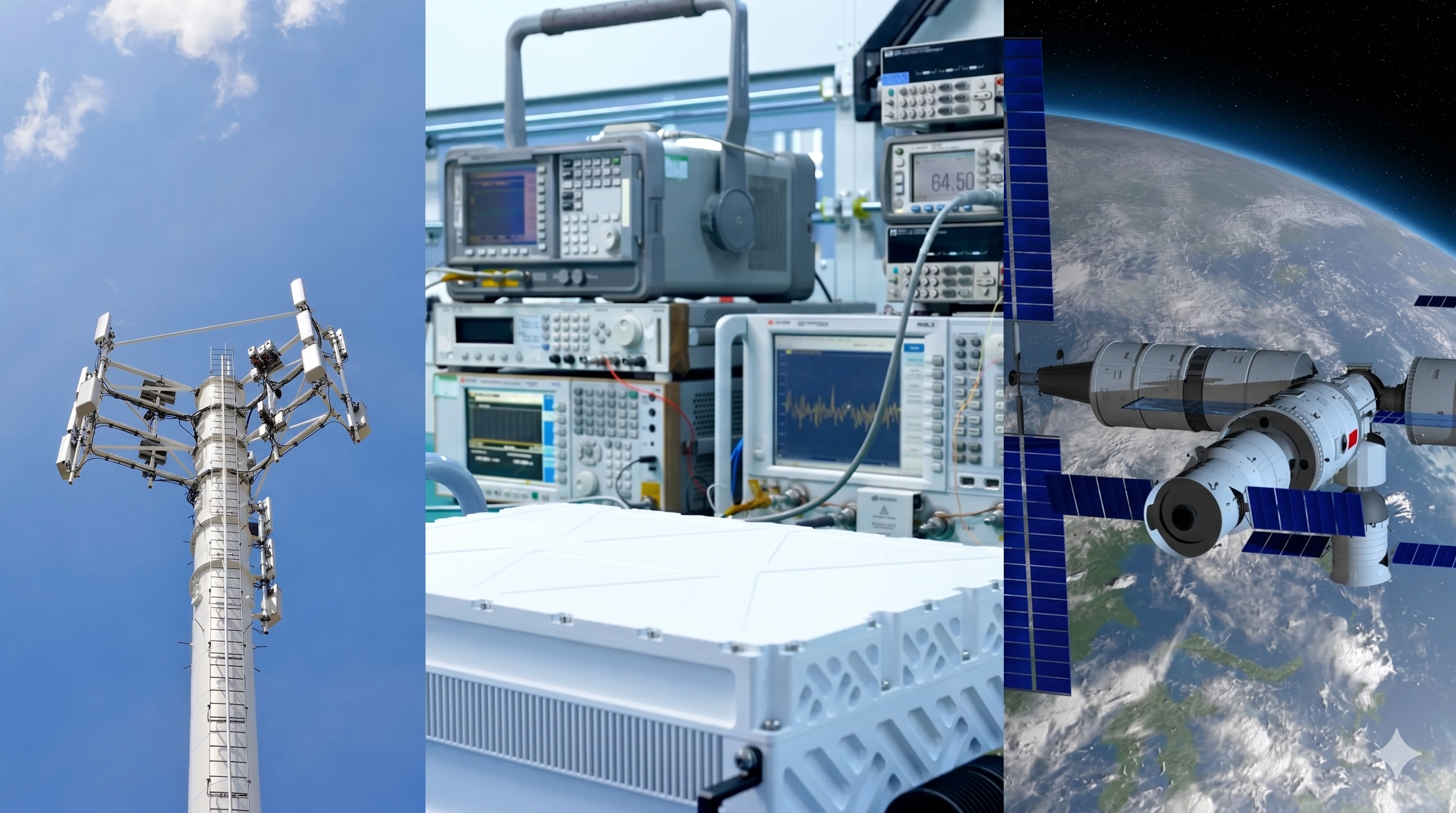
cURL Too many subrequests by single Worker invocation. To configure this limit, refer to https://developers.cloudflare.com/workers/wrangler/configuration/#limits.
cURL Too many subrequests by single Worker invocation. To configure this limit, refer to https://developers.cloudflare.com/workers/wrangler/configuration/#limits
- cURL Too many subrequests by single Worker invocation. To configure this limit, refer to https://developers.cloudflare.com/workers/wrangler/configuration/#limits cURL Too many subrequests by single Worker invocation. To configure this limit, refer to https://developers.cloudflare.com/workers/wrangler/configuration/#limits.
- cURL Too many subrequests by single Worker invocation. To configure this limit, refer to https://developers.cloudflare.com/workers/wrangler/configuration/#limits cURL Too many subrequests by single Worker invocation. To configure this limit, refer to https://developers.cloudflare.com/workers/wrangler/configuration/#limits.
- cURL Too many subrequests by single Worker invocation. To configure this limit, refer to https://developers.cloudflare.com/workers/wrangler/configuration/#limits cURL Too many subrequests by single Worker invocation. To configure this limit, refer to https://developers.cloudflare.com/workers/wrangler/configuration/#limits.
- cURL Too many subrequests by single Worker invocation. To configure this limit, refer to https://developers.cloudflare.com/workers/wrangler/configuration/#limits cURL Too many subrequests by single Worker invocation. To configure this limit, refer to https://developers.cloudflare.com/workers/wrangler/configuration/#limits.
Konklusyon
cURL Too many subrequests by single Worker invocation. To configure this limit, refer to https://developers.cloudflare.com/workers/wrangler/configuration/#limits.
cURL Too many subrequests by single Worker invocation. To configure this limit, refer to https://developers.cloudflare.com/workers/wrangler/configuration/#limits. ↩
cURL Too many subrequests by single Worker invocation. To configure this limit, refer to https://developers.cloudflare.com/workers/wrangler/configuration/#limits. ↩
cURL Too many subrequests by single Worker invocation. To configure this limit, refer to https://developers.cloudflare.com/workers/wrangler/configuration/#limits. ↩
cURL Too many subrequests by single Worker invocation. To configure this limit, refer to https://developers.cloudflare.com/workers/wrangler/configuration/#limits. ↩
cURL Too many subrequests by single Worker invocation. To configure this limit, refer to https://developers.cloudflare.com/workers/wrangler/configuration/#limits. ↩
cURL Too many subrequests by single Worker invocation. To configure this limit, refer to https://developers.cloudflare.com/workers/wrangler/configuration/#limits. ↩
Explore how error signals are generated and used in ALC systems. ↩
Learn about the function of variable attenuators in controlling RF power. ↩
Discover the mechanics of PIN diode attenuators in maintaining output power. ↩
Understand how adjusting amplifier bias contributes to output stability. ↩
Understand the importance of ALC in ensuring accurate test results. ↩
Learn how ALC enhances the accuracy of radar measurements. ↩
Discover the impact of temperature variations on RF systems. ↩

 Cebuano
  English
  Spanish (Spain)
  Arabic
  French (France)
  Vietnamese
  Indonesian
  Belarusian
  Moroccan Arabic
  Tibetan
  Danish
  Bulgarian
  Bosnian
  Catalan
  Frisian
  Japanese
  Bashkir
  French (Belgium)
  Estonian
  Hindi
Hindi  Kurdish
  Tahitian
  Spanish (Colombia)
  Croatian
  Breton
  Georgian