
Getting maximum power from your SSPA without creating signal distortion is a constant challenge. This trade-off between power and linearity often forces unwanted compromises in system design and efficiency.
The best way to optimize an SSPA is by using Digital Pre-Distortion (DPD).1 DPD digitally models the amplifier's non-linear behavior, including memory effects2, and creates an inverse distortion signal. This pre-corrected signal, when amplified, results in a clean, linear output even near saturation.
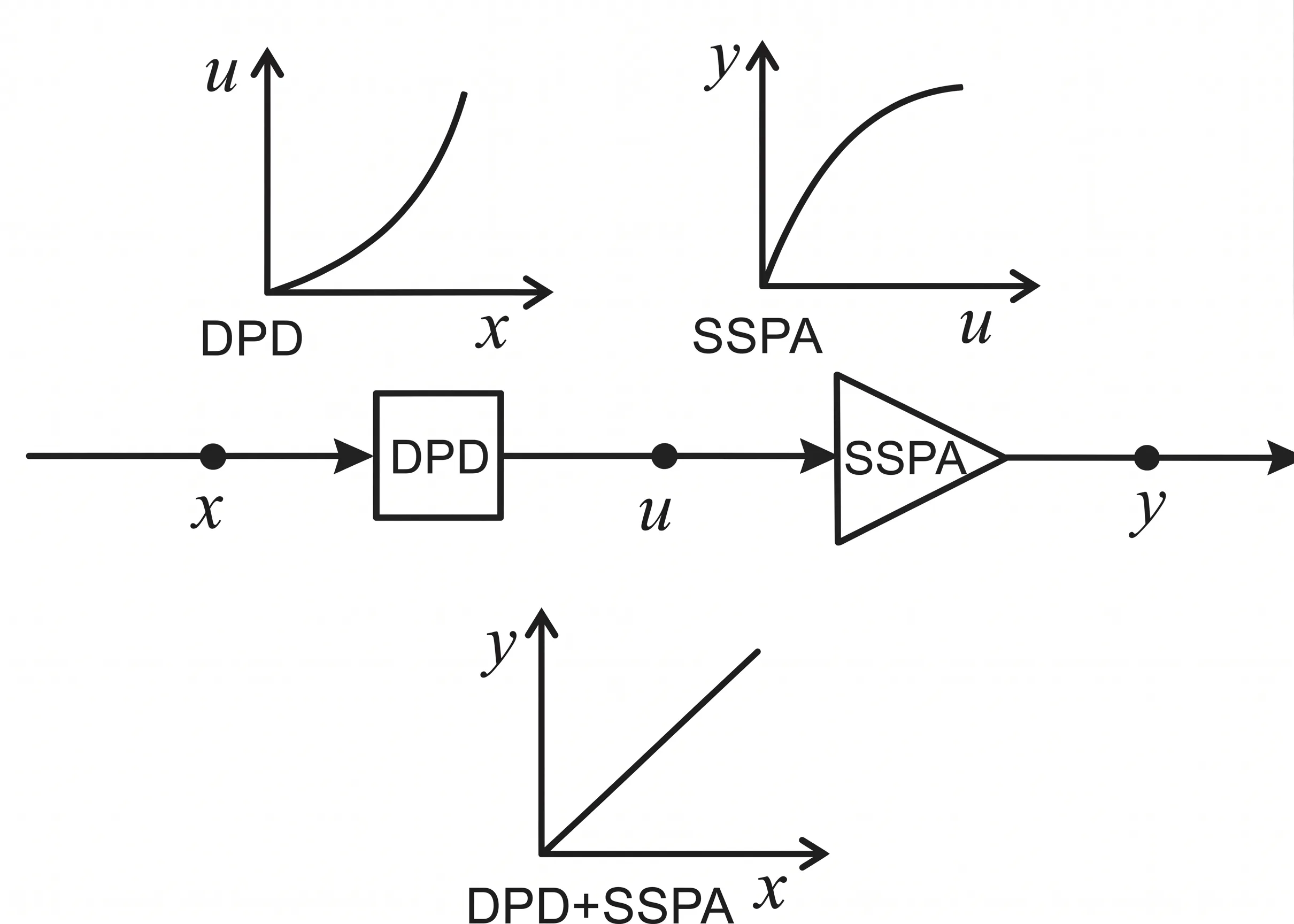
I've spent years in the lab pushing amplifiers to their limits. The goal is always the same: get as much clean power as possible. You need high linearity for today’s complex modulation schemes, but you also need high efficiency to manage power and heat. It’s a difficult balancing act. This is where understanding different linearization techniques becomes critical. Let's look at why DPD has become the go-to solution for high-performance systems and how it compares to older methods.
Why Does SSPA Linearity Matter So Much?
Your amplifier is pushing out a signal, but is it the right signal? Non-linearity distorts your waveform, causing it to spill into adjacent channels, which can ruin system performance.
SSPA linearity is critical because it directly impacts signal quality and spectral efficiency. A linear amplifier faithfully reproduces the input signal, preventing data corruption and interference with nearby channels. This is essential for modern communication systems that use spectrally dense modulation schemes.

Deeper Dive: The Real-World Impact of Non-Linearity
When an SSPA operates in its non-linear region, it generates unwanted distortion products. This isn't just a theoretical problem; it has serious practical consequences that I've seen derail projects. The two main types of distortion, AM-AM and AM-PM, directly degrade signal quality.
Key Performance Metrics Affected
The most common metric we use to measure this is the Adjacent Channel Power Ratio (ACPR)3. It tells us exactly how much of our signal power is leaking into the bands where it shouldn't be. Another is the Error Vector Magnitude (EVM)4, which measures how far the actual received symbols deviate from their ideal locations in the constellation diagram. Poor linearity leads to high spectral regrowth (bad ACPR) and a scattered constellation (bad EVM). For systems like 5G, satellite communications, and military radar, this is unacceptable. It can mean dropped calls, slow data, or even a complete loss of signal lock. The table below shows how linearity impacts different applications.
| བེད་སྤྱོད་ས་ཁོངས། | Impact of Poor Linearity | རྒྱུ་མཚན་གལ་ཆེན། |
|---|---|---|
| Satellite Comms | Adjacent channel interference | Prevents using adjacent transponders, wasting expensive satellite bandwidth. |
| 5G/Cellular Base Stations | Reduced data throughput (low EVM) | Fails to meet 3GPP standards, leading to poor user experience. |
| Test & Measurement | Inaccurate device characterization | The amplifier's distortion masks the true performance of the device under test. |
| Electronic Warfare | Unintended emissions | Can reveal the transmitter's location or interfere with friendly systems. |
Ultimately, maintaining linearity is about ensuring the integrity and efficiency of the entire RF system.
What Are the Limits of Analog Pre-Distortion?
Engineers have tried to fix non-linearity for decades. An early solution was analog pre-distortion (APD). But it often creates more problems than it solves, especially with modern wideband signals.
Analog pre-distortion is limited because it uses simple, memoryless circuits. These circuits cannot model or correct for an SSPA's dynamic memory effects, which are a major source of distortion. As a result, APD only provides a small improvement of a few dB in ACPR.

cURL Too many subrequests by single Worker invocation. To configure this limit, refer to https://developers.cloudflare.com/workers/wrangler/configuration/#limits
cURL Too many subrequests by single Worker invocation. To configure this limit, refer to https://developers.cloudflare.com/workers/wrangler/configuration/#limits.
cURL Too many subrequests by single Worker invocation. To configure this limit, refer to https://developers.cloudflare.com/workers/wrangler/configuration/#limits
cURL Too many subrequests by single Worker invocation. To configure this limit, refer to https://developers.cloudflare.com/workers/wrangler/configuration/#limits cURL Too many subrequests by single Worker invocation. To configure this limit, refer to https://developers.cloudflare.com/workers/wrangler/configuration/#limits5. cURL Too many subrequests by single Worker invocation. To configure this limit, refer to https://developers.cloudflare.com/workers/wrangler/configuration/#limits.
cURL Too many subrequests by single Worker invocation. To configure this limit, refer to https://developers.cloudflare.com/workers/wrangler/configuration/#limits.
cURL Too many subrequests by single Worker invocation. To configure this limit, refer to https://developers.cloudflare.com/workers/wrangler/configuration/#limits.
| cURL Too many subrequests by single Worker invocation. To configure this limit, refer to https://developers.cloudflare.com/workers/wrangler/configuration/#limits | Description | cURL Too many subrequests by single Worker invocation. To configure this limit, refer to https://developers.cloudflare.com/workers/wrangler/configuration/#limits |
|---|---|---|
| cURL Too many subrequests by single Worker invocation. To configure this limit, refer to https://developers.cloudflare.com/workers/wrangler/configuration/#limits | cURL Too many subrequests by single Worker invocation. To configure this limit, refer to https://developers.cloudflare.com/workers/wrangler/configuration/#limits. | cURL Too many subrequests by single Worker invocation. To configure this limit, refer to https://developers.cloudflare.com/workers/wrangler/configuration/#limits. cURL Too many subrequests by single Worker invocation. To configure this limit, refer to https://developers.cloudflare.com/workers/wrangler/configuration/#limits. |
| cURL Too many subrequests by single Worker invocation. To configure this limit, refer to https://developers.cloudflare.com/workers/wrangler/configuration/#limits | cURL Too many subrequests by single Worker invocation. To configure this limit, refer to https://developers.cloudflare.com/workers/wrangler/configuration/#limits. | cURL Too many subrequests by single Worker invocation. To configure this limit, refer to https://developers.cloudflare.com/workers/wrangler/configuration/#limits. cURL Too many subrequests by single Worker invocation. To configure this limit, refer to https://developers.cloudflare.com/workers/wrangler/configuration/#limits. |
| cURL Too many subrequests by single Worker invocation. To configure this limit, refer to https://developers.cloudflare.com/workers/wrangler/configuration/#limits | cURL Too many subrequests by single Worker invocation. To configure this limit, refer to https://developers.cloudflare.com/workers/wrangler/configuration/#limits. | cURL Too many subrequests by single Worker invocation. To configure this limit, refer to https://developers.cloudflare.com/workers/wrangler/configuration/#limits. cURL Too many subrequests by single Worker invocation. To configure this limit, refer to https://developers.cloudflare.com/workers/wrangler/configuration/#limits. |
Because APD can't address memory effects, its ability to improve ACPR is fundamentally capped. We saw this firsthand; a 3-5 dB improvement was the best we could achieve. For modern standards, that simply isn't enough.
How Does DPD Overcome SSPA Memory Effects?
After the limited success with APD, we switched our focus to Digital Pre-Distortion (DPD). The difference was night and day. DPD doesn't just approximate; it models the amplifier's real behavior.
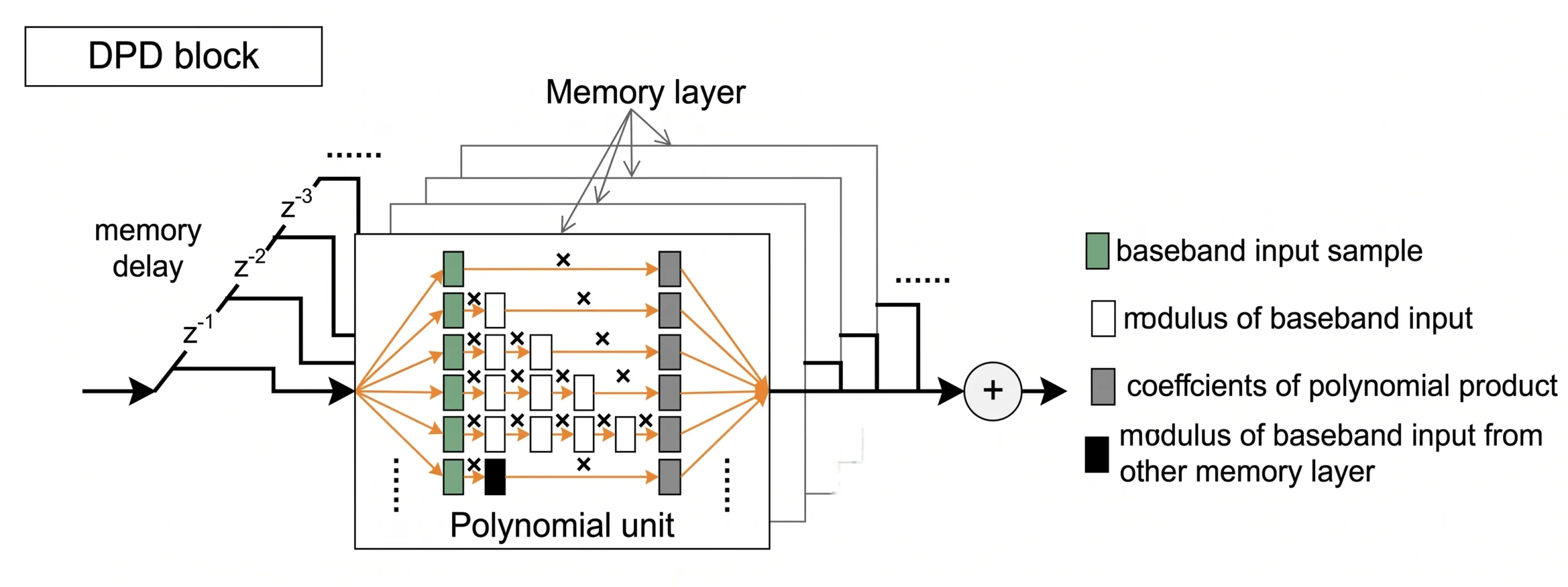
DPD overcomes memory effects by using advanced digital models, like the memory polynomial. This model captures not only the amplifier's static non-linearity but also its dynamic, time-dependent behavior. By accurately predicting the total distortion, DPD can generate a precise inverse signal to cancel it out.
Deeper Dive: Modeling and Canceling Distortion
The magic of DPD happens in the digital domain, usually within an FPGA or DSP, long before the signal ever reaches the SSPA. It's a two-step process: learning and correcting.
Understanding the DPD Correction Process
First, the DPD system "learns" the SSPA's unique distortion fingerprint. It sends a known signal through the amplifier and captures the distorted output. A feedback path brings this output signal back to the digital processor. Here, an adaptation algorithm compares the original signal to the distorted one. This comparison allows it to build a highly accurate mathematical model of the amplifier's behavior, including its memory effects.
The most common model used is the Generalized Memory Polynomial (GMP)6. This model is powerful because it includes "taps" that look at previous signal samples.
y(n): The predicted distorted output at timen.x(n-q): The input signal at previous time stepsq.a_kq: Coefficients that represent the amplifier's distortion characteristics.
The model uses these coefficients to predict exactly how the SSPA will distort any given input.
Creating the "Anti-Distortion" Signal
Once the model is built, the DPD system enters its correction phase. For any new input signal x(n) that needs to be transmitted, the DPD block uses the GMP model to pre-emptively calculate the inverse of the distortion the SSPA will add. It warps the signal in the opposite direction of the amplifier's distortion. When this pre-distorted signal passes through the SSPA, the amplifier's own distortion effectively cancels out the pre-distortion, resulting in a clean, linear output. This process is continuous, allowing the DPD to adapt to changes in temperature or device aging. This is how we can achieve ACPR improvements of 15 dB or more7, something impossible with APD.
What Are the Practical Benefits of Using DPD with SSPAs?
Implementing DPD isn't just an academic exercise. For us and our customers, it translates directly into better performance, lower costs, and a more competitive product.
The main benefit of DPD is that it allows SSPAs to run much closer to their saturation point while maintaining excellent linearity. This dramatically improves power efficiency8, reduces heat and operational costs, and enables the use of smaller, less expensive amplifiers for the same output power.

Deeper Dive: Translating Technical Gains into Business Value
When we can run an SSPA closer to its peak power, a cascade of positive effects occurs. On that satellite project I mentioned, implementing DPD meant we could meet the strict out-of-band emissions requirements without having to back off the power significantly. This had huge implications for the client.
Key Business and System Advantages
The improvement in ACPR is the technical enabler, but the real-world value is what matters to system designers and business owners. The ability to operate at a higher power-added efficiency (PAE) is probably the most significant benefit.
- Reduced Operational Costs (OPEX): A more efficient amplifier consumes less DC power and generates less waste heat. This leads to lower electricity bills and reduced cooling requirements, which are major operational expenses in data centers and base stations.
- Reduced Capital Costs (CAPEX): Since DPD allows you to get more linear power out of a given amplifier, you can often use a smaller, less expensive SSPA to do the job of a much larger, un-linearized one. For example, a DPD-enabled 100W SSPA might deliver the same linear output power as a 200W SSPA operating with a large back-off9.
- Enhanced System Performance: The clean signal produced by a DPD-linearized SSPA supports higher-order modulation schemes. This translates to higher data throughput and better spectral efficiency, allowing operators to serve more users or transmit more data in the same amount of bandwidth.
cURL Too many subrequests by single Worker invocation. To configure this limit, refer to https://developers.cloudflare.com/workers/wrangler/configuration/#limits.
| cURL Too many subrequests by single Worker invocation. To configure this limit, refer to https://developers.cloudflare.com/workers/wrangler/configuration/#limits | cURL Too many subrequests by single Worker invocation. To configure this limit, refer to https://developers.cloudflare.com/workers/wrangler/configuration/#limits | cURL Too many subrequests by single Worker invocation. To configure this limit, refer to https://developers.cloudflare.com/workers/wrangler/configuration/#limits |
|---|---|---|
| cURL Too many subrequests by single Worker invocation. To configure this limit, refer to https://developers.cloudflare.com/workers/wrangler/configuration/#limits | cURL Too many subrequests by single Worker invocation. To configure this limit, refer to https://developers.cloudflare.com/workers/wrangler/configuration/#limits. | cURL Too many subrequests by single Worker invocation. To configure this limit, refer to https://developers.cloudflare.com/workers/wrangler/configuration/#limits. |
| cURL Too many subrequests by single Worker invocation. To configure this limit, refer to https://developers.cloudflare.com/workers/wrangler/configuration/#limits | cURL Too many subrequests by single Worker invocation. To configure this limit, refer to https://developers.cloudflare.com/workers/wrangler/configuration/#limits. | cURL Too many subrequests by single Worker invocation. To configure this limit, refer to https://developers.cloudflare.com/workers/wrangler/configuration/#limits. |
| cURL Too many subrequests by single Worker invocation. To configure this limit, refer to https://developers.cloudflare.com/workers/wrangler/configuration/#limits | cURL Too many subrequests by single Worker invocation. To configure this limit, refer to https://developers.cloudflare.com/workers/wrangler/configuration/#limits. | cURL Too many subrequests by single Worker invocation. To configure this limit, refer to https://developers.cloudflare.com/workers/wrangler/configuration/#limits. |
| cURL Too many subrequests by single Worker invocation. To configure this limit, refer to https://developers.cloudflare.com/workers/wrangler/configuration/#limits | cURL Too many subrequests by single Worker invocation. To configure this limit, refer to https://developers.cloudflare.com/workers/wrangler/configuration/#limits. | cURL Too many subrequests by single Worker invocation. To configure this limit, refer to https://developers.cloudflare.com/workers/wrangler/configuration/#limits. |
cURL Too many subrequests by single Worker invocation. To configure this limit, refer to https://developers.cloudflare.com/workers/wrangler/configuration/#limits.
མཇུག་སྡོམ།
cURL Too many subrequests by single Worker invocation. To configure this limit, refer to https://developers.cloudflare.com/workers/wrangler/configuration/#limits.
"cURL Too many subrequests by single Worker invocation. To configure this limit, refer to https://developers.cloudflare.com/workers/wrangler/configuration/#limits. ↩
"cURL Too many subrequests by single Worker invocation. To configure this limit, refer to https://developers.cloudflare.com/workers/wrangler/configuration/#limits. ↩
"cURL Too many subrequests by single Worker invocation. To configure this limit, refer to https://developers.cloudflare.com/workers/wrangler/configuration/#limits. ↩
"cURL Too many subrequests by single Worker invocation. To configure this limit, refer to https://developers.cloudflare.com/workers/wrangler/configuration/#limits. ↩
"Research of Electro-Thermal Memory Effect of RF Power Amplifier ...", https://ui.adsabs.harvard.edu/abs/2006ceem.conf..184Y/abstract. A scholarly article on power amplifier modeling can be used to support the claim that memory effects arise from physical phenomena, including self-heating of the transistor die and the frequency-dependent nature of the amplifier's bias and matching networks. Evidence role: mechanism; source type: paper. Supports: The physical mechanisms that cause memory effects in SSPAs, specifically linking them to thermal time constants and the frequency-dependent impedance of the bias circuitry.. ↩
"A Generalized Memory Polynomial Model for Digital ...", https://ptacts.uspto.gov/ptacts/public-informations/petitions/1557523/download-documents?artifactId=_WgqK9D4EM0FR-HC62WNFgycROgDX0Lfg7EZFcNzitP9BfaGxIm7z6c. A foundational or review paper on DPD techniques can be cited to establish the Generalized Memory Polynomial (GMP) as a prominent and powerful model for accurately capturing both static non-linearities and dynamic memory effects in power amplifiers. Evidence role: general_support; source type: paper. Supports: That the Generalized Memory Polynomial (GMP) is a widely used and effective model for implementing digital pre-distortion systems.. Scope note: The source may not explicitly state it is the 'most common' but will demonstrate its widespread use and importance in the field. ↩
"Digital Predistortion and Measurement Method | Instrumentation", https://instrumentationjournal.com/index.php/instr/article/view/126. A research paper presenting experimental results of a DPD implementation can provide measured data showing ACPR improvements of 15 dB or more, validating the high level of performance achievable with this technique. Evidence role: statistic; source type: paper. Supports: That DPD systems can achieve significant ACPR improvements, often exceeding 15 dB.. Scope note: The exact improvement is dependent on the specific amplifier, signal, and DPD implementation, so the source provides an example of this performance rather than a universal guarantee. ↩
"How DPD improves power amplifier efficiency", https://www.powerelectronictips.com/how-dpd-improves-power-amplifier-efficiency/. A study on the efficiency of linearized power amplifiers can explain that DPD enables the SSPA to operate at a higher average power level, closer to its peak efficiency point, without violating spectral emission masks, thereby improving overall system efficiency. Evidence role: mechanism; source type: paper. Supports: That DPD improves the overall power efficiency of a transmitter by allowing the SSPA to be operated closer to its saturation region, where its Power-Added Efficiency (PAE) is highest.. ↩
"Comparison of Feature Selection Techniques for Power Amplifier ...", https://pmc.ncbi.nlm.nih.gov/articles/PMC8433820/. An educational resource or application note can illustrate the concept of power back-off, showing that an amplifier may need to operate at half its rated power (a 3 dB back-off) or less to achieve required linearity, a limitation that DPD mitigates. Evidence role: case_reference; source type: education. Supports: The principle that using DPD allows a smaller amplifier to produce the same linear power as a larger amplifier that must be 'backed off' from its saturation point.. Scope note: The source will support the principle with a similar example, though the exact 100W vs. 200W figures are illustrative. ↩

 Tibetan
  English
  Spanish (Spain)
  Arabic
  French (France)
  Vietnamese
  Indonesian
  Belarusian
  Moroccan Arabic
  Danish
  Bulgarian
  Bosnian
  Catalan
  Frisian
  Japanese
  Bashkir
  Cebuano
  French (Belgium)
  Estonian
  Hindi
Hindi  Kurdish
  Tahitian
  Spanish (Colombia)
  Croatian
  Breton
  Georgian